
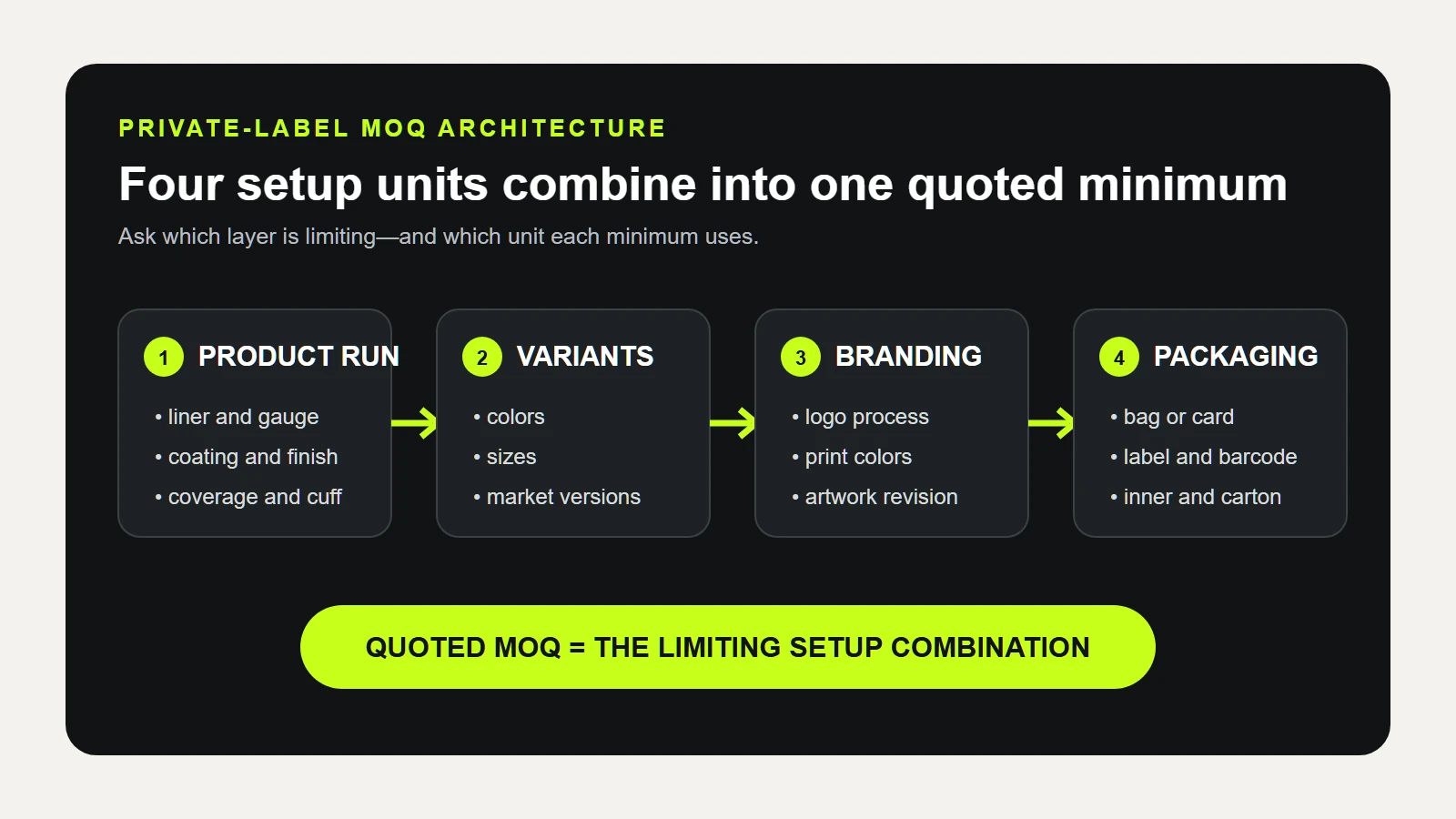
A private-label work glove MOQ is not one universal factory number. The workable minimum depends on what must be produced together: the base glove construction, material or color batch, quantities by size, logo process, printed packaging and final pack format. A catalog construction with a simple approved mark may follow a different route from a new liner color, coating change and fully printed retail pack. Ask the supplier to show which layer sets the minimum, which quantities apply per SKU or variant, and which printed components have separate run requirements. FENGAN confirms the actual MOQ only after reviewing the current specification and packing brief.
Treat MOQ as a stack of setup decisions
The useful question is not simply “What is your MOQ?” It is “What is the minimum for this exact product, variant plan and packing route?” One order can contain several constraints measured in different units. The glove may be counted in pairs, a print process by color and position, and a paper card or carton by artwork version.
Separate those layers before comparing offers:
| MOQ layer | What creates a separate setup | What the buyer should ask | Common way to simplify |
|---|---|---|---|
| Base glove run | Liner, gauge, coating family, finish, coverage, cuff or other construction changes | Is the minimum per construction, per supplier SKU or across compatible styles? | Start from one existing construction and change only what the market needs |
| Material and color | Custom yarn color, coating color or another material direction | Which colors share materials and which require separate preparation? | Use an available color for the first run or concentrate volume in one colorway |
| Size allocation | The total is divided among sizes that must remain operationally feasible | Is the stated minimum total, per size or subject to a workable size mix? | Build the size mix from wearer or sell-through evidence before requesting the quote |
| Logo application | Artwork, print color, placement and process create their own setup | Is the minimum per logo, color, placement or glove style? | Keep one logo version and one approved placement initially |
| Printed packaging | Each card, bag, label or carton artwork may be a separate printed component | Does each size, barcode or language version create another print item? | Use a shared design with controlled variable labels where the supplier confirms it is feasible |
| Finished pack | Inner quantity, single-size or mixed-size packing and outer carton rules shape the final order | How are product quantity and printed-component quantity reconciled? | Confirm pack multiples only after the demand by SKU and size is visible |
This framework does not predict FENGAN's MOQ or another supplier's production economics. It gives the buyer a way to expose the assumptions behind a quotation.
Fix the base glove before discussing a branded minimum
MOQ discussions become unreliable when “the glove” is still a moving target. A switch from nitrile to latex, from foam to smooth finish, from palm coating to broader coverage, or from one liner gauge to another is not a cosmetic adjustment. It changes the product being quoted and may change materials, process, sample requirements and the production run.
Start with a product code, an approved physical sample or a written construction. The FENGAN coated work glove range separates nitrile, latex, PU and PVC families so buyers can narrow the product first. If an existing model is used as the base, record the exact liner, gauge, coating, finish, coverage, cuff, sizes and color before adding private-label requirements.
For example, the current FG-NF01 foam nitrile coated glove is presented as a 15-gauge nylon/spandex seamless knit with microfoam nitrile on the palm and fingertips, in quotation sizes 7/S through 12/3XL. That description identifies one reference construction; it does not establish a standard MOQ for every size mix, color or pack. A change that produces a different construction needs a new quotation and appropriate sample review.
A coating name alone is not proof of chemical, cut, puncture, waterproof, thermal or other protective performance. If the destination market requires a particular claim or document, it must be confirmed for the exact quoted glove rather than added to artwork as a branding choice.
Count variants the way production and packaging see them
A buyer may view one green glove in six sizes as one product. Production and packing may see six size allocations, six size marks, and potentially six packaging or barcode versions. The total order quantity therefore does not answer whether each variant can be produced and packed as requested.
Create a variant matrix before asking for a firm MOQ. Use one row for every sellable combination:
| Buyer SKU | Base construction | Colorway | Size | Logo version | Pack artwork | Barcode or market version | Required quantity |
|---|---|---|---|---|---|---|---|
| One row per variant | Exact, not “same as sample” | Named or approved reference | One offered size | File revision and colors | Card, bag, label or none | Exact data source | Buyer demand |
Then ask the supplier to mark which rows can share a production run and which require separate setup. Never assume that adding all rows together satisfies every component minimum.
The quantity by size should come from the buyer's workforce or sales evidence, not a convenient split chosen only to reach a factory total. The guide to building a work glove size mix for a bulk order shows how to use measured demand, sample fitting, usable stock and pack rounding without inventing a universal size ratio.
Separate the glove minimum from the print minimum
Private-label projects often combine a production quantity with items purchased or prepared through different processes. Back-of-hand printing, a paper card, an OPP bag, a wash label and an outer carton are not one interchangeable “custom package.” Each may have its own artwork, material, supplier, print method and usable remainder.
The FENGAN private-label packaging guide lists the decisions buyers should lock: logo placement, card, bag, label, barcode, inner quantity, outer packing and shipping marks. This MOQ article has a different job. It helps the buyer identify which of those decisions creates a separate economic or operational minimum.
Ask these questions for every printed component:
- What is the ordering unit: pieces, sheets, rolls, bags, labels, cards or cartons?
- Does the minimum apply per artwork, size, barcode, language, color or material?
- Can several glove sizes share one design with a controlled variable label?
- If the print run exceeds the first glove order, who owns and stores the unused balance?
- How will remaining components be identified, protected and reconciled on a repeat order?
- Can an artwork revision make stored items unusable?
- Are setup, plate or tooling items quoted separately, and are they reusable for the same approved revision?
Leftover packaging does not automatically reduce the next MOQ. It has value only when the next order uses the same approved design, data and pack construction and when the supplier confirms that the material remains usable.
Choose a branding route that matches launch risk
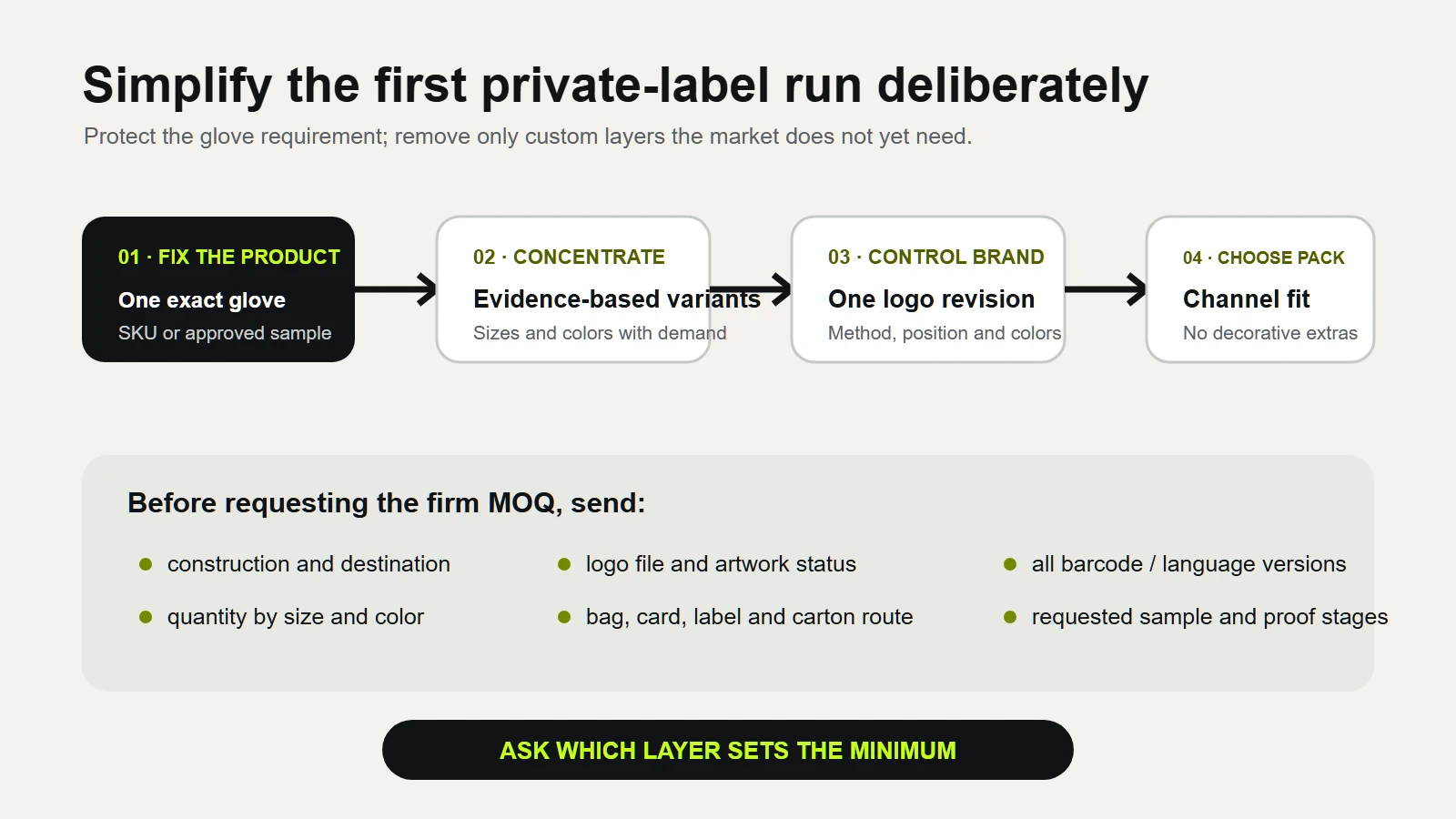
“Private label” can mean anything from one mark on an existing glove to a new construction with a retail presentation. Those routes carry different setup burdens. A buyer launching an unproven line should decide which custom elements are necessary for market acceptance and which can wait for demand evidence.
Use this sequence:
- Protect the product requirement. Keep the construction, fit and required destination evidence ahead of decorative changes.
- Choose one base SKU. Avoid launching several nearly identical constructions before sell-through is known.
- Limit the first color direction. Every extra color can divide volume and add another approval trail.
- Use one controlled logo version. Fix placement, dimensions, print colors and file revision.
- Select the simplest valid pack. A neutral inner pack plus controlled label may be appropriate for some channels; retail buyers may require a card, individual bag and barcode. The channel requirement decides—not a generic low-MOQ promise.
- Add variants deliberately. Add another market, language, barcode or carton design only when its demand justifies a separate controlled item.
Simplifying the pack must not remove required product identification, traceability or destination-market information. The buyer remains responsible for defining what the target channel and market require; the supplier should confirm what can be produced for the exact order.
Approve samples without confusing sample quantity and production MOQ
A development sample, a print proof and a bulk-production minimum answer different questions. A supplier may be able to prepare a small number of samples for evaluation even when the eventual production run is much larger. That does not mean the sample quantity is the production MOQ.
Build the approval chain in stages:
- Construction reference: confirms the liner, coating, finish, coverage, cuff and intended size system.
- Logo or artwork proof: confirms file revision, placement, dimensions and colors for the proposed method.
- Pack mockup or proof: confirms the card, bag, label, barcode, size mark and carton information.
- Pre-production or approved sample: ties the final glove and pack decisions to the order specification.
Use the coated work glove sample approval checklist to record what was actually approved. Approval of a construction sample does not extend to an unreviewed logo method or new package.
The order should state what happens if a sample change affects the MOQ. For example, a new color, logo process or package revision may invalidate an earlier quotation. Ask for the supplier to identify the changed setup rather than returning only a new total.
Compare MOQ quotations on the same scope
Two suppliers can quote different minimums while describing different deliverables. One may include a standard construction and neutral export packing; another may include a custom liner color, logo, printed card and market-specific barcode. The lower number is not necessarily the more flexible or complete offer.
For each quotation, record:
- Minimum by base construction and colorway.
- Allowed size allocation and any size-level constraint.
- Logo method, number of colors, positions and artwork revision.
- Minimum and excess quantity for every printed packaging component.
- Whether the quoted quantity is pairs, inner packs, cartons or another unit.
- Treatment of unused labels, cards, bags or cartons.
- Sample, proof and approval stages included in the scope.
- The assumptions that would trigger a requote.
The coated work glove quotation comparison guide provides a broader line-by-line method for comparing construction, size, packing, evidence and commercial terms. Use it with the variant matrix so the same definition of the product sits behind every MOQ.
Reduce an initial MOQ without hiding the trade-offs
A buyer can ask for a more workable first order, but the request should reduce setup complexity instead of simply demanding a smaller total. Practical options to discuss include:
- Use one existing glove construction rather than developing several new styles.
- Keep one liner and coating color direction for the launch.
- Concentrate the first order on the evidence-based size mix rather than splitting volume across speculative variants.
- Use one logo version and one placement.
- Share a packaging design across sizes only where variable identification remains accurate and the supplier confirms the route.
- Stage a retail-pack change after product demand is established.
- Ask whether unused printed components can be documented and carried into a repeat order under the same artwork revision.
Each option has a consequence. A simpler pack may not fit a retail channel. Fewer colors may limit assortment. Carrying unused printed material creates storage and obsolescence risk. The correct decision balances launch risk, channel requirements and reorder confidence; it does not minimize quantity at any cost.
Send an MOQ-ready RFQ
An effective MOQ request gives the supplier enough detail to quote the actual setup while leaving room to propose a simpler alternative. Include:
- Product code, reference sample or complete glove construction.
- Application and destination market.
- Total quantity and quantity by size.
- Number of colorways and the reference for each color.
- Logo file, position, dimensions, colors and preferred method if known.
- Pack route: neutral or printed bag, paper card, wash label, inner quantity, carton and shipping marks.
- Every size, barcode, language or market-specific artwork version.
- Required sample and proof stages.
- Required product-specific standards or documents, without assuming they already exist.
- Request for a breakdown of the limiting MOQ layer and any separate component minimums.
- Request for an alternative based on fewer custom layers when the first plan is not feasible.
The FENGAN OEM and private-label page shows how product construction, brand artwork and packing belong in one approval trail. The order-control process connects that trail to sampling, production and inspection.
Send the exact glove, variant matrix, artwork status, packing route, quantity by size and destination through the FENGAN RFQ form. The useful answer is not a headline minimum. It is a current quotation that shows which setup drives the quantity, what can share a run, what remains separate and which change would require a new calculation.