
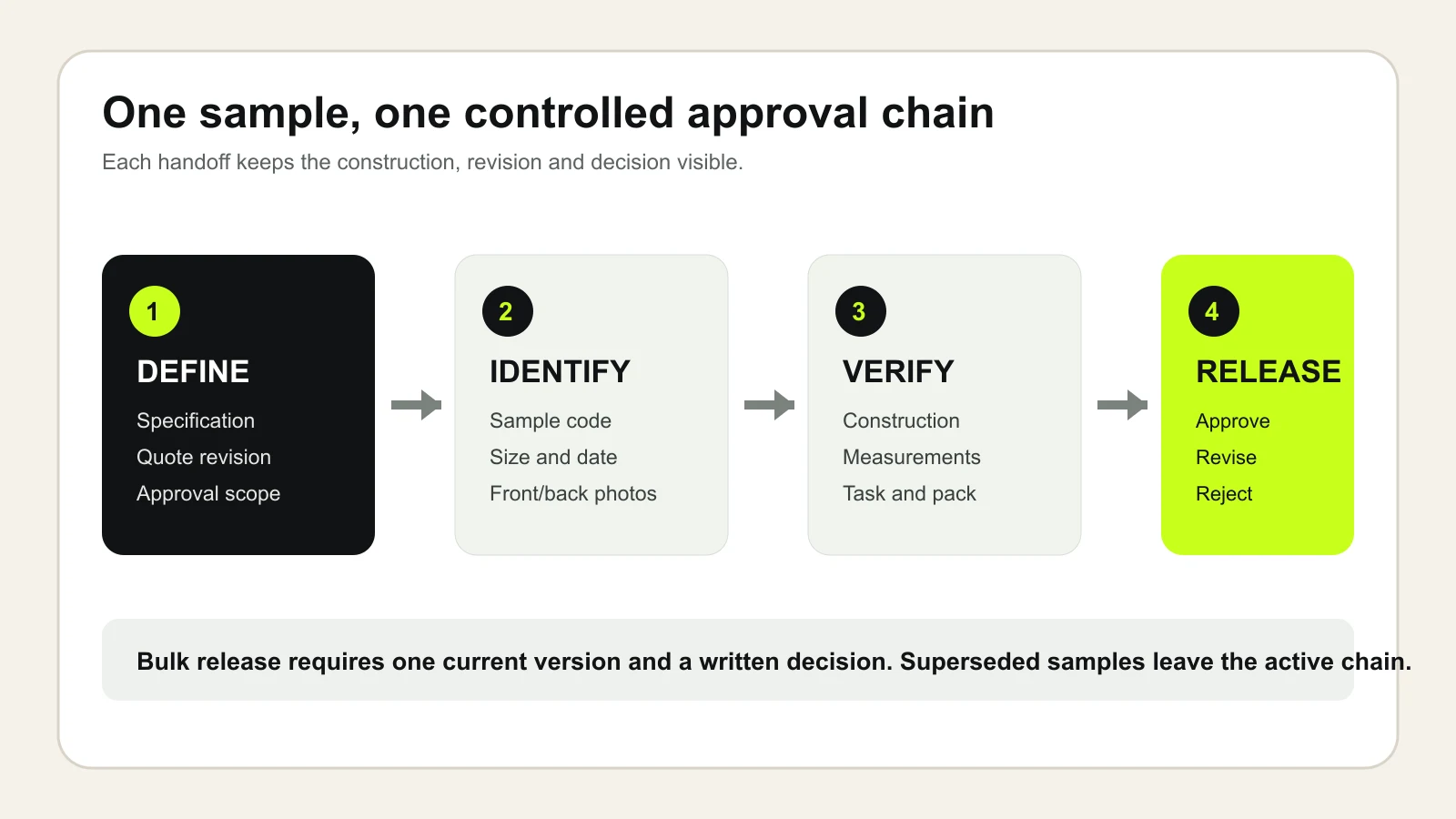
A coated work glove sample is ready for approval when one identified physical pair matches the written specification, passes the buyer's task-based review, and is tied to the correct artwork, packing and quotation revision. Record the sample code, date, size and every accepted exception. A message that only says “sample approved” leaves too much open for bulk production.
The aim is not to make one pair prove the quality of a future lot. The aim is to create a controlled reference that purchasing, production and inspection teams can identify in the same way.
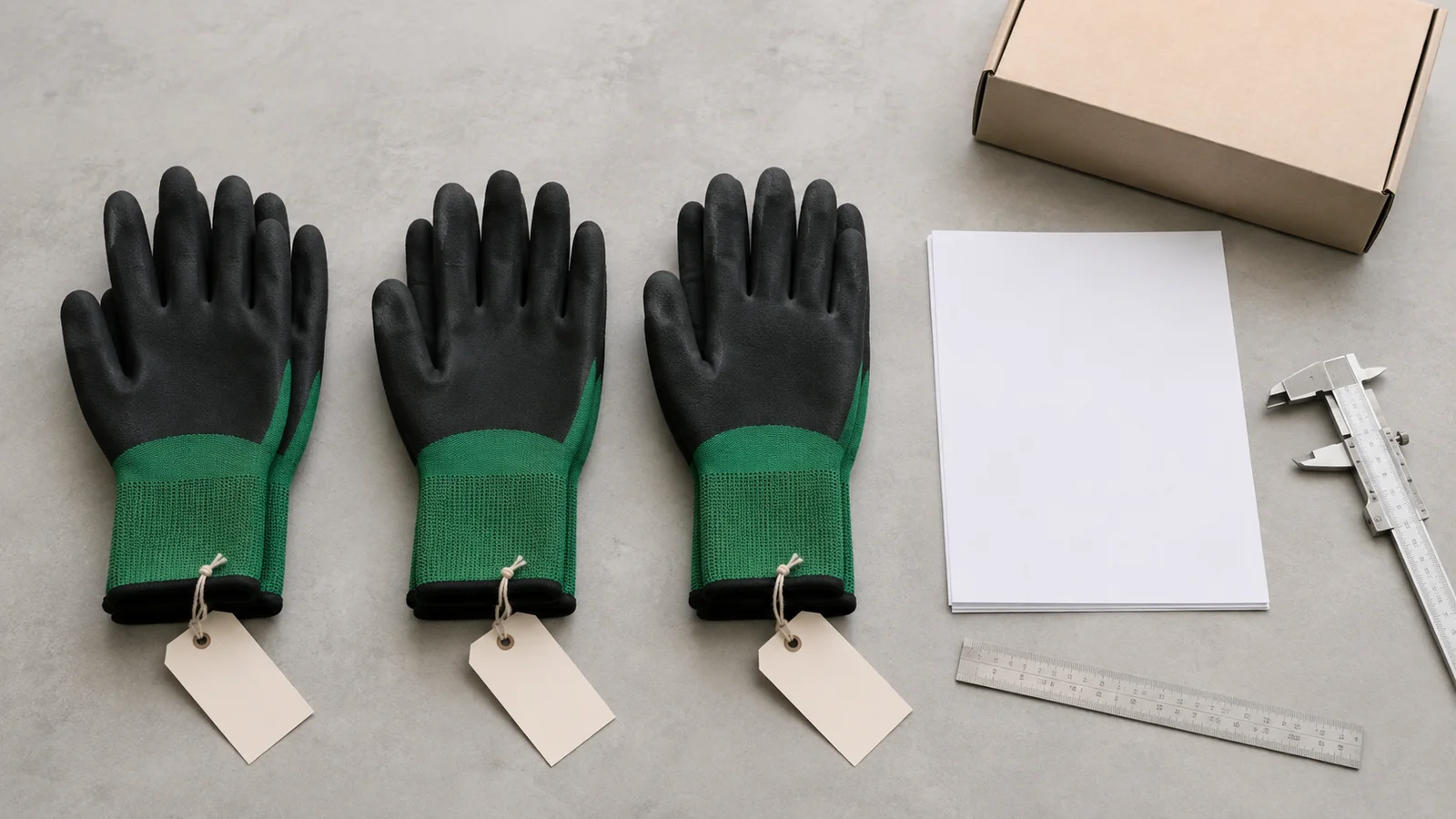
Build one approval record before testing the glove
Start with the documents that define the proposed order: the current quotation, buyer specification, artwork revision, packing plan and sample request. Assign one approval record to each materially different construction. A different liner, coating finish, coverage, size system or cuff is a different sample decision, even when the supplier uses the same family name.
The record needs enough identity detail for another reviewer to find the same pair:
- Supplier model and buyer SKU, if both exist.
- Sample code, shipment date and date received.
- Quotation and specification revision.
- Coating family, finish and coverage.
- Liner material and gauge.
- Cuff, color and size marking.
- Physical size being reviewed.
- Artwork and packing revision connected to the sample.
- Reviewer, test setting and final disposition.
This identity step prevents a catalogue photo, an earlier revision or a sample in another size from silently becoming the production reference. Buyers who are still defining the construction can begin with the guide on how to specify coated work gloves for wholesale orders. If the work environment has not been translated into a glove shortlist yet, use the industrial coated glove selection process first.
Use a decision table, not a general impression
The approval sheet can be short, but every line needs an observable result and a decision owner.
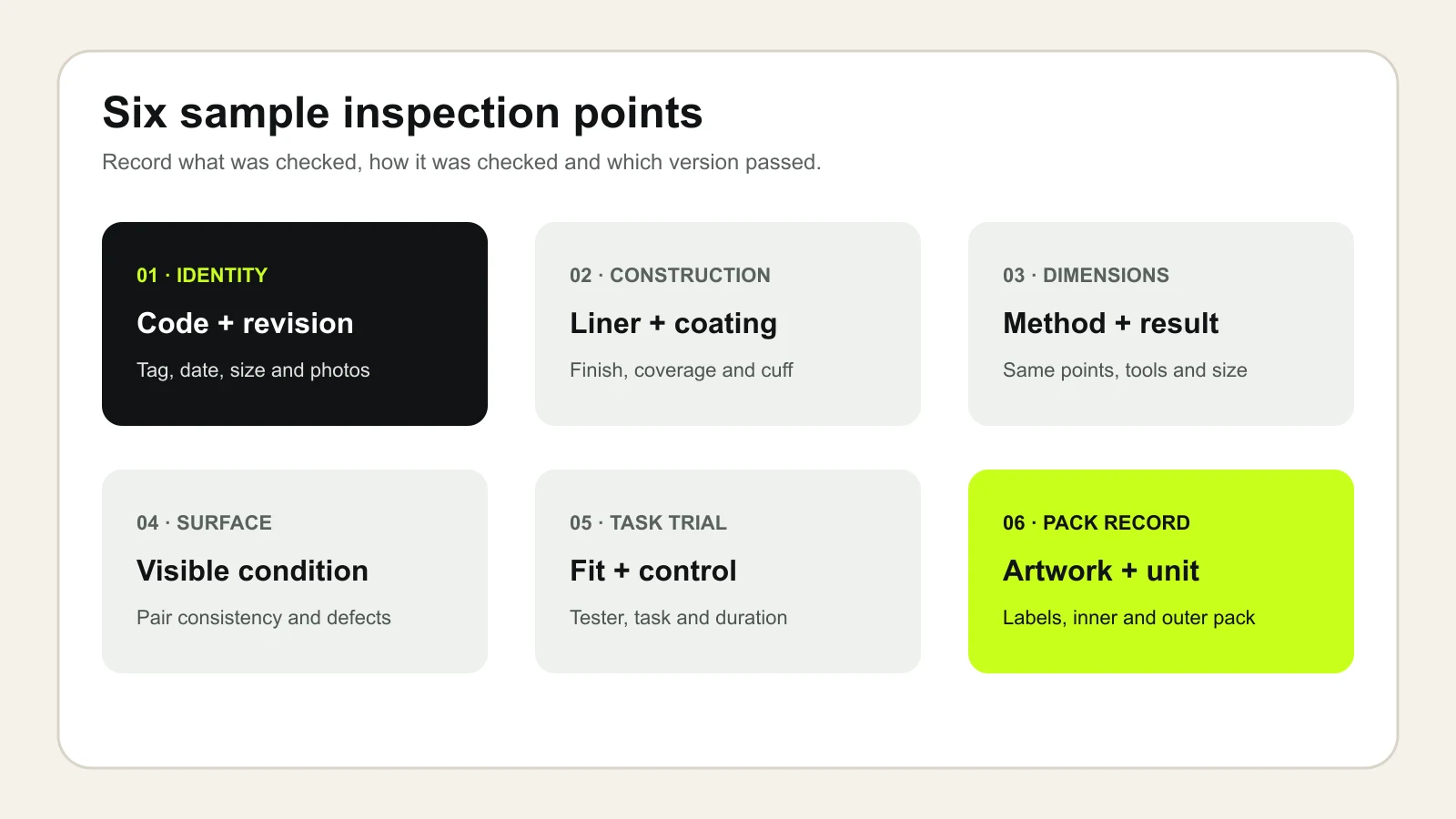
| Review area | What to record | Useful evidence | Release condition |
|---|---|---|---|
| Sample identity | Model, code, revision, date and size | Tag plus front-and-back photos | One traceable version |
| Construction | Liner, gauge, coating, finish, coverage and cuff | Written specification and physical pair | All required fields match or a deviation is accepted in writing |
| Dimensions and weight | Chosen dimensions, method and size-specific result | Measurement sheet | Buyer-defined limits are recorded and met |
| Surface and workmanship | Coverage boundary, texture, visible defects and pair consistency | Inspection photos and notes | Observable issues are resolved |
| Fit and task trial | Tester size, task, duration and feedback | Trial record | Intended users can perform the defined task within the buyer's acceptance criteria |
| Branding and packing | Print, labels, barcode data, inner pack and outer pack | Approved artwork and pack sample | Correct revision is connected to the glove |
| Required documents | Exact model and market scope | Current document list | Buyer or qualified reviewer confirms applicability |
| Final disposition | Approve, revise, reject or limit the approval scope | Signed or controlled record | Production receives one unambiguous decision |
Avoid a single combined score at the start. A good fit cannot cancel the wrong coating finish, and correct artwork cannot cancel a size mismatch. Close the hard identity and construction points first, then use a scorecard for softer factors such as comfort or worker preference.
Confirm the complete glove construction
Check the physical pair against the specification line by line. For coated work gloves, “nitrile glove” or “latex glove” is too broad to identify the product. The approval record needs the complete combination.
Liner and gauge. Record the stated fiber or blend, knit construction and gauge. Gauge comparisons stay connected to the actual yarn, coating and finished glove; the 13-gauge versus 15-gauge guide explains why the number alone cannot predict the buyer's preferred feel.
Coating family and finish. Distinguish nitrile, latex, PU and PVC, then name the actual finish such as foam, smooth, crinkle or another agreed texture. Similar colors are not evidence of the same material or finish.
Coverage. Photograph the palm, fingertips, knuckles, back and cuff. Mark the coating boundary on the approval sheet when coverage is commercially important. A palm-coated sample cannot approve a fully coated order.
Cuff, color and marking. Check cuff style, liner and coating colors, size identification and any requested back-of-hand print. Printed wording on an old sample never proves a rating or certificate for the current construction.
The FENGAN coated work glove range separates the main coating families and exact product pages. For example, the FG-NF01 foam nitrile coated glove has its own construction identity; it is not a visual substitute for a smooth nitrile, latex, PU or PVC sample.
Measure with a method the next reviewer can repeat
Measurements are useful only when the procedure is written down. Identify the size, sample count, conditioning or resting method where relevant, measurement points, tool and rounding rule. Place the glove flat without stretching unless the agreed method says otherwise.
Typical buyer-controlled fields include overall length, palm width, cuff dimensions and pair weight. A buyer may add finger lengths or other dimensions when fit, retail sizing or an established specification requires them. The acceptable limits belong in the purchase specification; they should never be invented during inspection.
Pair weight always stays attached to the tested size and exact construction. A value recorded for one size is not automatically the target for every other size. For a multi-size order, select representative sizes and define how the buyer will evaluate the size set.
When a result falls outside the agreed range, record the value and the sample identity. A vague note such as “slightly small” is hard to reproduce; a named measurement at a defined point gives the supplier something actionable.
Inspect coating and workmanship without overstating performance
Use consistent lighting and compare both gloves in the pair. Review the palm, fingertips, finger valleys, side walls, back and cuff. Record visible findings such as uneven coverage, thin areas, runs, contamination, stuck fingers, exposed liner where coating was required, edge irregularity, holes, tears or severe pair-to-pair differences.
Flexing and normal handling can reveal obvious cracking, tackiness or separation, but an office sample review is not a formal test of abrasion, cut, puncture, chemical, waterproof or thermal performance. Any required protection claim needs the relevant test method and exact-product evidence.
For workplace selection, OSHA connects hand protection to the task, present conditions, duration and identified hazards. That makes the buyer's real-use trial important, while keeping it separate from certified performance evidence.
Run a task-based fit and handling trial
Choose testers whose hand sizes match the intended workforce. Record the glove size, tester, task, duration and environment. Ask for observations tied to a location and action: fingertip excess while picking a small part, thumb restriction during a grip, cuff movement during repeated reach, or loss of control when handling the target surface.
Useful trial questions include:
- Can the wearer put on and remove the glove consistently?
- Does the glove allow the required grip, reach and finger control?
- Does the coating contact the intended work surface as expected?
- Are there pressure points, bunching, internal roughness or excessive movement?
- Does the glove remain acceptable for the defined trial period?
- Do different testers report the same issue at the same location?
The trial result applies to the tested construction and conditions. It does not create a universal application claim. Record separate evidence for any hazard-related requirement and involve the buyer's safety or compliance reviewer where the use demands it.
Connect branding and packing to the same approval
Private-label approval often fails when the glove and packaging are reviewed in separate message threads. Keep them under the same SKU and revision trail.
Check print position, scale and colors against the approved artwork. Review size marks and any requested labels. Confirm the sellable unit, pairs per inner pack, inner-pack format, barcode data, carton quantity and shipping marks. If a digital mockup is the only available pack reference, label it as artwork approval rather than a finished packing sample.
The FENGAN OEM and private-label process provides the commercial handoff for artwork and packing, while the private-label packaging guide helps buyers separate glove, label, inner-pack and outer-carton decisions.
A change to artwork, barcode data, size allocation or pack count can require a new approval even when the glove construction stays unchanged. The record should state whether the decision covers the physical glove only, packaging only, or the complete sellable unit.
Choose one clear disposition
End the review with a decision that production can act on.
- Approved for the stated order: The identified sample, specification, artwork and packing revision are aligned, with accepted deviations listed.
- Approved for a limited scope: One component, such as glove construction or artwork, is accepted while another remains open. The record states that bulk release is still pending.
- Revision required: The supplier receives numbered corrections and the buyer identifies which points require a revised physical sample, component proof or written confirmation.
- Rejected: The sample cannot serve as the intended reference. The reason is tied to measurable or observable findings.
Archive superseded records and mark the current version clearly. If the liner, coating, coverage, size system, artwork or packing changes after approval, assess the impact and issue a new revision. One active reference reduces the risk of a factory or inspection team comparing against the wrong pair.
Keep sample approval separate from lot acceptance
An approved sample defines the intended product; it does not guarantee that every unit in bulk production matches it. The purchase and inspection plan still needs lot definition, defect categories, sampling approach and acceptance rules appropriate to the order.
ISO 2859-1:2026 defines AQL-indexed sampling schemes for lot-by-lot inspection. Choosing an inspection level, AQL and acceptance plan is a separate buyer decision based on risk and purchasing requirements. A supplier's sample approval form is not a substitute for that plan, and a later inspection result should be compared against the written specification and controlled reference.
The FENGAN order-control page shows where specification, approved sample, production checks and packing verification meet. The earlier guide on comparing coated work glove quotations can help align commercial scope before the sample is signed off.
RFQ handoff: send the information needed for the right sample
Before requesting a sample, prepare this short pack:
- Intended task, work surface, environment and hazard assessment context.
- Coating family, finish and coverage.
- Liner, gauge, cuff, colors and size range.
- Reference glove, specification or product link.
- Measurements and buyer-defined limits that matter.
- Required market documents or test evidence for the exact product.
- Logo file, print position, labels, barcode and packing concept.
- Expected order quantity and size mix for a current commercial review.
- Destination market and target review date.
- Names of the buyer's technical, safety, branding and purchasing approvers.
Use the checklist to approve a traceable version, not an impression. When the requirements are ready, send the sample brief, expected quantity, sizes, packing and destination through the FENGAN RFQ form. The response can then identify the right product route and the points that need confirmation before a sample is prepared.