
To compare coated work glove quotations fairly, use three passes. First confirm that every supplier quoted the same glove construction. Next normalize quantity, sizes, packing, branding and trade terms. Finally, record every deviation and verify the shortlisted offer against an exact sample and matching evidence. A unit price only becomes comparable after those three checks.
This approach keeps a cheap but altered construction from outranking a complete offer. It also gives the buyer a clean list of questions to resolve before sample approval or a purchase decision.
Start with one locked comparison baseline
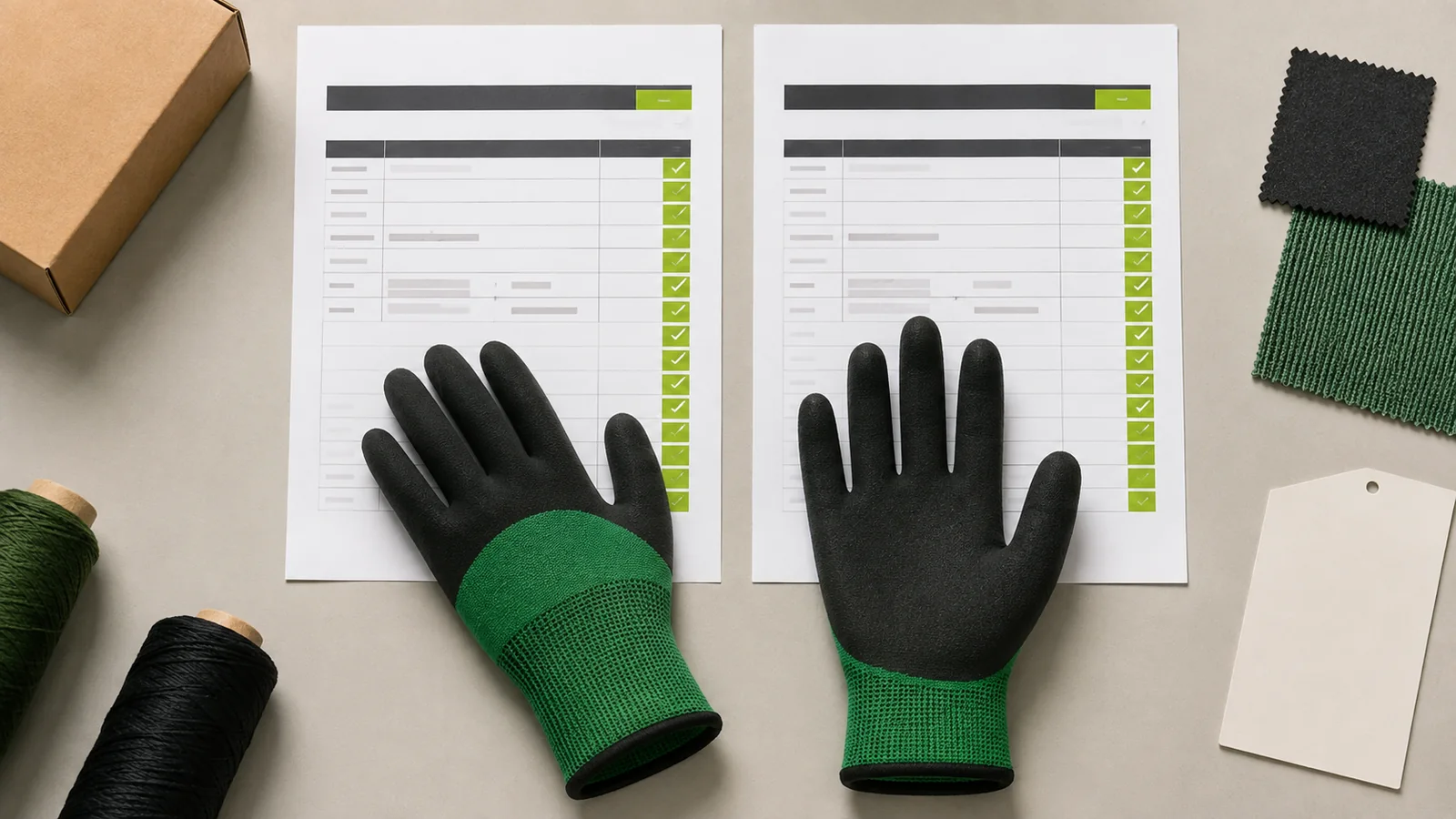
Place the issued RFQ, drawing or approved reference at the left side of the comparison sheet. Give it a revision number and date. Each quotation then gets its own column, while the buyer records one of four results for every line: match, deviation, missing or alternative.
That structure matters because supplier offers rarely arrive in identical formats. One may quote a 15-gauge foam nitrile glove in cartons, another may propose a 13-gauge smooth nitrile alternative in woven bags, and a third may leave coating finish unspecified. Those offers can all contain a price, but they describe different purchasing decisions.
The baseline needs enough detail to identify a complete glove rather than a broad family. The FENGAN guide on how to specify coated work gloves for wholesale orders provides a useful starting structure. When the application is still uncertain, use the industrial coated glove selection process before requesting final prices.
Compare the glove construction line by line
Begin with the physical product. Transfer the supplier's actual answer into the sheet, even when it differs from the requested value. Avoid replacing a deviation with a simple check mark.
| Comparison line | What needs to match or be stated | Why a difference matters |
|---|---|---|
| Product reference | Buyer SKU, supplier model, photo or physical sample code | Similar names can hide a different construction |
| Liner | Fiber, knit construction and gauge | Changes fit, feel, weight and the product being evaluated |
| Coating family | Nitrile, latex, PU or PVC for the exact offer | A family name alone is not a full specification |
| Coating finish | Smooth, foam, crinkle, textured or another defined finish | Finish changes the contact surface and sample decision |
| Coverage | Fingertip, palm, knuckle, full coat and cuff boundary as applicable | Different coverage means a visibly different glove |
| Cuff and dimensions | Cuff style, glove length and any controlled dimensions | Affects fit, handling and packing |
| Color and markings | Liner, coating, size mark and approved print position | Relevant to assortment control and private label approval |
| Sizes | Offered range and quantity by size | A total quantity without a size mix can conceal availability gaps |
| Pair-weight basis | Exact size and construction attached to the reference | A weight for one size cannot represent every size automatically |
For gauge comparisons, the 13-gauge versus 15-gauge coated glove guide explains why gauge needs to stay connected to yarn, coating and finished feel. The same logic applies to finish and coverage: changing one line creates an alternative, not an equivalent quote.
Keep alternatives visible instead of averaging them away
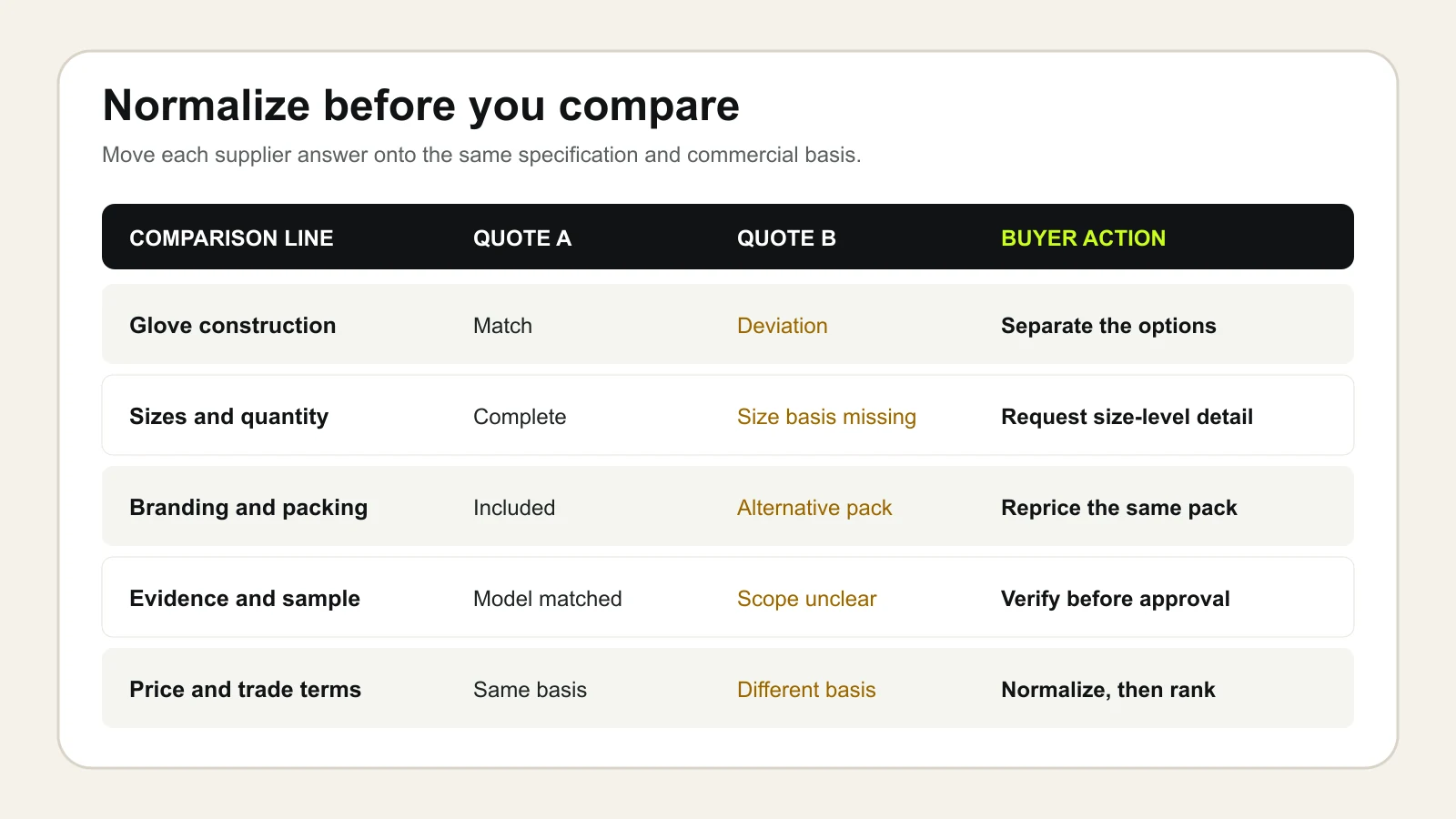
An alternative can be useful. A supplier may propose another liner, coating finish, pack count or production route for a valid commercial reason. The comparison becomes unreliable only when the alternative is treated as though it matched the original request.
Create a separate option row for each proposed change. Ask the supplier to price the requested specification and the alternative independently where both are available. This preserves the buyer's ability to decide whether the change deserves a new sample, a revised requirement or rejection.
A short variance log works well:
| Deviation ID | Quotation line | Supplier proposal | Buyer decision | Follow-up evidence |
|---|---|---|---|---|
| D-01 | Exact field | Proposed change | Accept, reject or sample | Photo, revised sample or document |
| D-02 | Exact field | Missing answer | Clarify | Written confirmation |
Use IDs in emails and meeting notes. “Please clarify D-02” is easier to track than a general request to revise the quotation.
Match performance evidence to the quoted construction
A material label or catalogue image is not proof of protection. OSHA's hand-protection rule connects glove selection to the task, conditions, duration and hazards. Its PPE selection guidance also advises purchasers to request documentation for the appropriate test standards tied to anticipated hazards.
For each required rating or destination-market document, compare:
- The product or model named in the quotation.
- The liner, coating, finish and coverage in the offered construction.
- The model or construction within the report or declaration scope.
- The requested target market and required marking or documentation.
- The document date and the supplier's explanation of continued applicability.
Place general factory documents in a separate supplier-review section. A quality-system certificate and a product performance report answer different questions. Neither substitutes for a sample that matches the quoted glove.
Normalize sizes, quantity and unit basis
Many apparent price gaps come from a different denominator. Record the sellable unit first: pair, dozen pairs, inner pack, carton or another clearly defined unit. Convert offers into the same unit for comparison while keeping the original quotation value visible.
Then align the quantity tier. A price tied to one total quantity may not apply to a smaller trial order, a different size allocation or a split shipment. Ask whether the quoted quantity covers the full size mix and whether any size, color or branded component changes the applicable tier.
Pair-weight references need their size basis as well. A quotation that lists a weight without the applicable size and exact construction leaves an important comparison gap. Use the same size when evaluating weight across samples, and define the agreed control method before treating it as an order criterion.
Compare packing and branding as part of the product
Private-label offers can look identical at the glove level while carrying different packing scope. Put every component on its own line:
- Back-of-hand print, print colors and artwork setup.
- Size marking, wash label or cloth label where requested.
- Paper card, individual bag or multi-pair inner pack.
- Barcode data and label placement.
- Pairs per inner pack and inner packs per outer pack.
- Carton or woven-bag construction and shipping marks.
- Buyer-supplied versus supplier-supplied artwork or packaging files.
The FENGAN OEM and private-label page shows how glove construction, artwork and packing belong in one approval trail. For a deeper packing review, use the guide to private-label packaging for work gloves.
If one supplier quotes a plain bulk pack and another includes printed cards, bags and cartons, the unit prices are not yet on the same basis. Request a like-for-like pack or keep the offers as separate commercial options.
Put commercial terms on the same basis
After the product and pack match, normalize the commercial lines.
| Commercial field | Record in the comparison sheet |
|---|---|
| Currency and unit | Currency, price per defined unit and conversion date if the buyer converts it |
| Quantity tier | Total pairs and size allocation connected to the price |
| Trade term | Named term and named place, plus what the supplier includes |
| Packing scope | Included pack components and outer-pack basis |
| Samples and setup | Any separately stated sample, print, tooling or artwork cost where applicable |
| Payment basis | Deposit, balance trigger and payment method stated in the offer |
| Quotation validity | Expiry date or stated validity period |
| Delivery assumption | What starts the timing and which approvals must be complete first |
| Shipment arrangement | Single or split shipment and any quantity assumptions |
Keep product value, packing additions, one-time charges and logistics scope on separate lines. A single “total” can hide whether a cost is recurring, conditional or excluded. The goal is not to predict landed cost from incomplete data; it is to show which numbers share the same basis and which still need work.
Six quotation gaps worth stopping to clarify
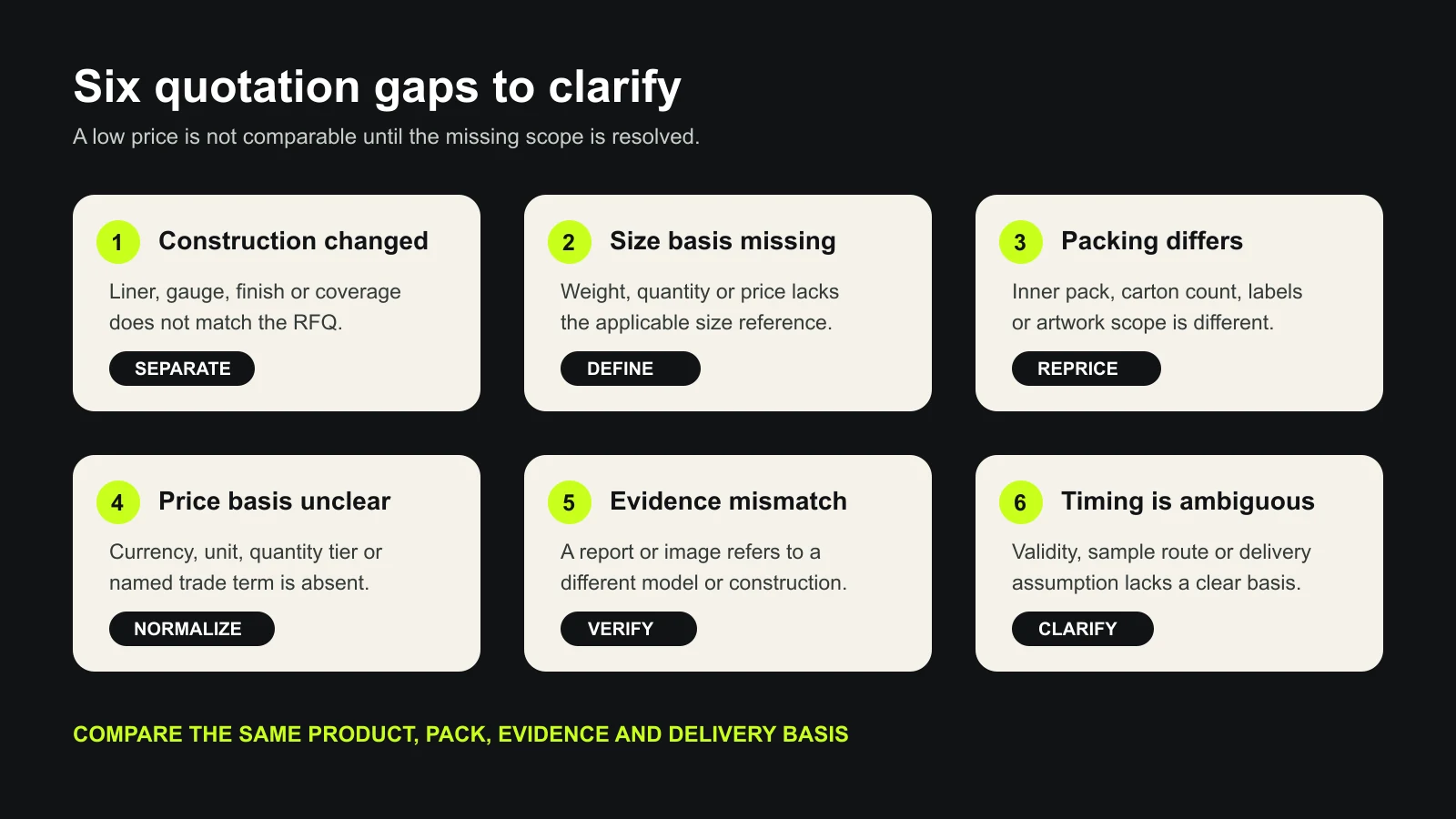
- The construction changed silently. The offered liner, gauge, finish or coverage differs from the RFQ, but the quotation presents it as a direct match.
- The size basis is missing. Quantity, pair weight or price is listed without the applicable size or size mix.
- Packing differs. Inner packs, outer quantity, labels, cards or artwork are excluded or replaced by another format.
- The price basis is unclear. Currency, unit, quantity tier, trade term or named place is absent.
- Evidence refers to another product. A report, declaration or image cannot be connected to the quoted model and construction.
- Timing is ambiguous. Validity, sample route, approval trigger or delivery assumption has no clear basis.
These gaps are questions, not automatic accusations. A clear supplier reply may resolve them quickly. The risk comes from ranking the offer before the answer is documented.
Rank offers only after technical normalization
Once the comparison lines are complete, separate the decision into three views.
Technical conformance shows whether the offered glove matches the requested construction and required evidence. Commercial comparison covers normalized price, pack, quantity and trade terms. Execution confidence covers the clarity of the response, sample traceability, approval route and handling of deviations.
Choose weights that reflect the actual program. A private-label retail pack may place more emphasis on artwork and packing control. A regulated PPE purchase may place more emphasis on exact-model evidence. A repeat industrial order may emphasize consistency with the approved sample and previous specification.
Keep any nonconforming option visible even if its calculated score looks attractive. A total score should support judgment, not erase a product difference.
Validate the shortlist with the exact sample
The preferred quotation is still a paper offer until the sample is tied to it. Ask the supplier to identify the sample with a model or sample code and confirm the lines that matter: liner, gauge, coating family, finish, coverage, cuff, color and size.
Run the sample in the representative task and workforce sizes defined by the buyer's hazard assessment. Record fit, control, comfort and observable construction features separately from any formal protection evidence. Photograph the approved sample, retain its identity and connect the result to the quotation revision.
Before order approval, compare the sample record with the FENGAN order-control process: specification, sample, artwork, packing and document scope need to describe the same product. A later material, construction or packing change belongs in a new review rather than an informal substitution.
Send one focused clarification request
After the first review, send suppliers a numbered list instead of forwarding a crowded spreadsheet without context. Include:
- RFQ revision and quotation reference.
- Each missing or deviating line by ID.
- Requested specification beside the supplier's current answer.
- Whether the buyer needs a corrected quote, an alternative option or a sample.
- Evidence or photo needed for the exact model.
- Required currency, unit, quantity tier, packing and named trade basis.
- Size mix, branding files and destination-market information still to be confirmed.
- Reply date and the buyer's next review step.
This gives every supplier the same chance to complete the comparison. It also leaves a clean record for sample approval and later purchase-order review.
Final decision rule
Compare coated work glove quotations in this order: product, evidence, pack, commercial basis, then price. If two offers still describe different constructions or scopes, treat them as alternatives until the differences are priced and sampled openly.
Browse the FENGAN coated work glove range to define the starting construction. When you are ready to compare a live offer, send the specification, quotation gaps, target quantity, size mix, branding, packing and destination through the FENGAN RFQ form. FENGAN can respond against the same line-by-line basis rather than a generic “best price” request.