
Build a work glove size mix from evidence about the people or customers who will use the exact glove—not from a generic S/M/L percentage. Count demand by size, validate the size chart with samples of the proposed construction, add only a buyer-approved allowance, and then round quantities to feasible pack units. Record every rounding change so it does not silently become the next order's “standard” ratio.
This method works for an end-user site, a distributor and a private-label program, but the input data differs. A factory can confirm available sizes and packing options; it cannot know the buyer's workforce or sell-through pattern without the buyer's data.
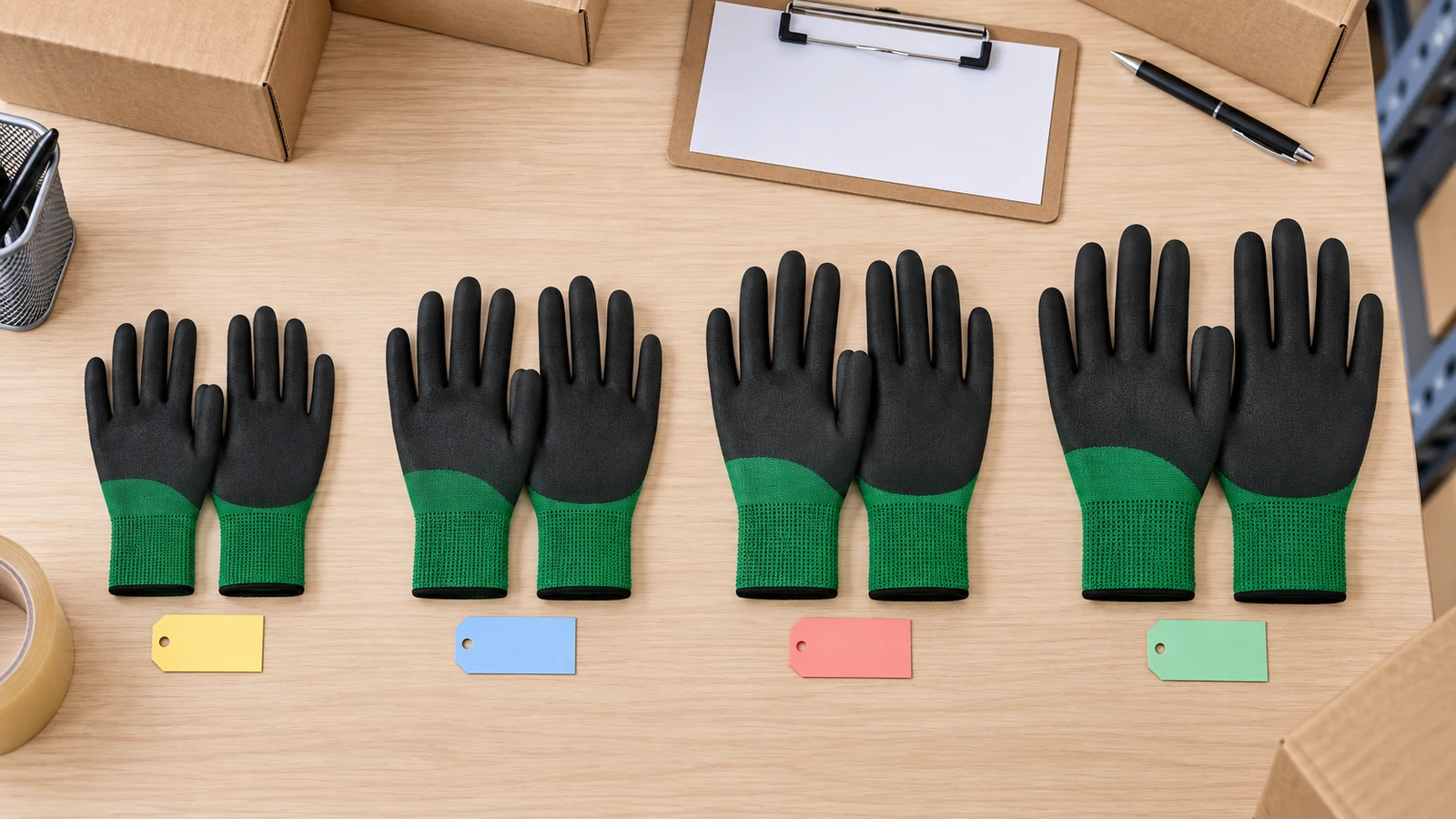
Start with the exact glove and the demand population
Calculate the size mix only after fixing the product identity. The same letter size can fit differently when the liner yarn, gauge, coating, cuff or pattern changes. A chart for one supplier or construction cannot be transferred automatically to another.
Define one planning line with:
- Buyer SKU and supplier model or a clear product reference.
- Liner, gauge, coating family, finish, coverage and cuff.
- The supplier's current size chart and its revision date.
- The people, sites, departments or sales channel covered by the order.
- The issue period or selling period the quantity is meant to support.
- The pack and carton rules that will be confirmed in the quotation.
The FENGAN coated work glove range separates coating families and constructions so a buyer can start from a specific product. For example, the current FG-NF01 foam nitrile coated glove page lists quotation sizes 7/S through 12/3XL. That is an example for this SKU, not a promise that every FENGAN glove uses the same range or fit. Final sizes, packing and commercial terms belong in the current quotation and approved sample.
Choose the evidence route that matches the buying situation
The strongest size mix uses the closest available demand signal. The decision table below keeps buyers from treating a weak assumption as measured demand.
| Buying situation | Best starting evidence | What to calculate | Main validation step |
|---|---|---|---|
| Existing workforce, named wearers | One measurement and trial record per wearer | Wearers by approved size and planned issue frequency | Trial the exact construction across boundary sizes |
| Existing site, incomplete roster | Recent issue records plus a representative measured sample | Historic use by size, adjusted for headcount and role changes | Check unexplained shortages and leftover stock |
| Distributor or retailer | Sell-through, returns and stockouts by SKU and size | Demand by size for the defined market and selling period | Separate lost sales from genuinely low demand |
| New facility or new market | Measured pilot group, staffing plan and controlled sample order | Provisional mix by role, site and wearer count | Start with a limited pilot and label the result provisional |
| Promotional or uncertain recipient pool | Event or customer profile, if available | An explicitly assumption-based allocation | Isolate the risk and avoid reusing it as workforce PPE data |
Published web results often present ready-made percentage splits. Those numbers may describe a particular seller, workforce or market, but they cannot establish the correct allocation for another buyer. Without traceable population and product data, a fixed ratio is only a planning assumption.
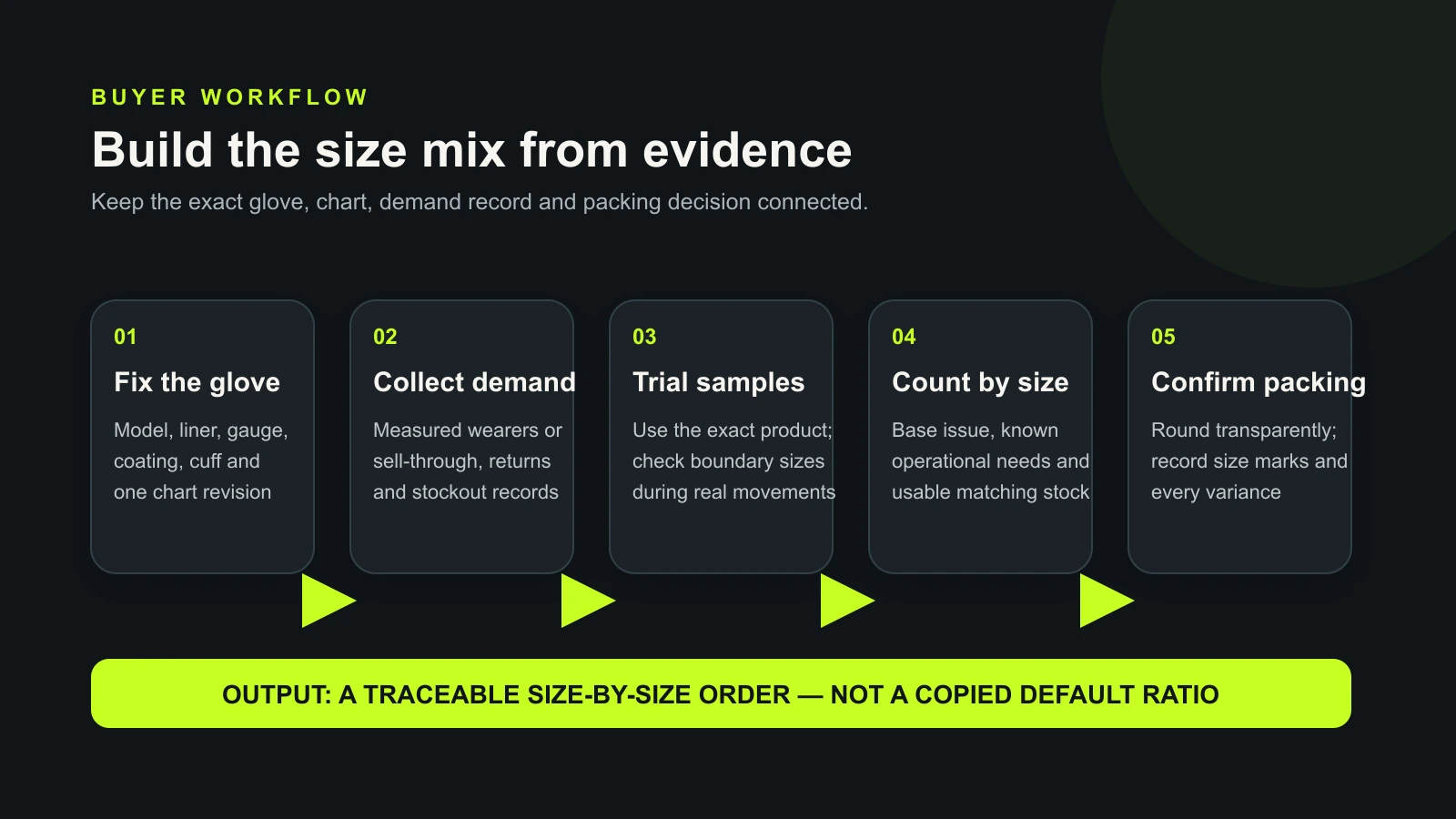
Measure hands against one documented chart
Use the measuring method supplied for the exact glove program. At minimum, record which hand dimension was used, the unit, whether the dominant hand was measured, and how a boundary result was assigned. Keep circumference data from one chart separate from hand-length cutoffs in another.
ISO 21420:2020 is the current published international standard covering general requirements and relevant test procedures for protective-glove design, construction, comfort and efficiency. It does not make one supplier's letter size interchangeable with another supplier's product. The practical procurement control is therefore to keep the chart, model and sample together.
A measurement roster can contain:
| Record field | Why it matters |
|---|---|
| Anonymous wearer or role ID | Allows repeat review without putting personal names in the purchase order |
| Site and department | Reveals whether one location or task group has a different demand pattern |
| Recorded hand measurement | Preserves the result before it is converted to a size label |
| Chart revision and proposed size | Shows which rule converted the measurement into S, M, L or a numeric size |
| Trial result | Captures whether the exact glove fits during the intended movement |
| Approved size and exception note | Separates the final decision from the first chart suggestion |
For privacy and practicality, procurement usually needs aggregate counts by size, not personal measurements. Keep any detailed roster under the buyer's own access controls and send the supplier only the quantities and specification needed for the order.
Validate fit with samples of the exact construction
Measurement is a screening step; sample fitting is the release step. Use the same liner, gauge, coating, cuff and intended size marking as the quoted product. A loose uncoated liner or another coating finish is not a substitute for the final construction.
Include wearers near the boundaries between sizes, plus representatives from the main task groups. Ask them to perform the movements that matter: grasping the actual handle, picking the actual component, flexing at the knuckles and maintaining fingertip control. Record observable outcomes rather than a single “comfortable” score.
Check:
- Fingertip space and whether excess material folds during precision handling.
- Palm and back-of-hand tension during a closed grip.
- Cuff position and whether it interferes with the work clothing used on site.
- Seam or coating pressure points during repeated motion.
- Whether the wearer consistently chooses a different size after the task trial.
- Whether a size exception is caused by individual preference, the chart or the glove pattern.
The coated work glove sample approval checklist explains how to tie the reviewed pair to one traceable specification. Size approval does not prove chemical, cut, puncture, waterproof, thermal or other protective performance. Required protection and documentation must still be assessed for the exact glove and hazard.
Convert the roster into quantities by size
Build the calculation in layers so every addition has an owner and reason.
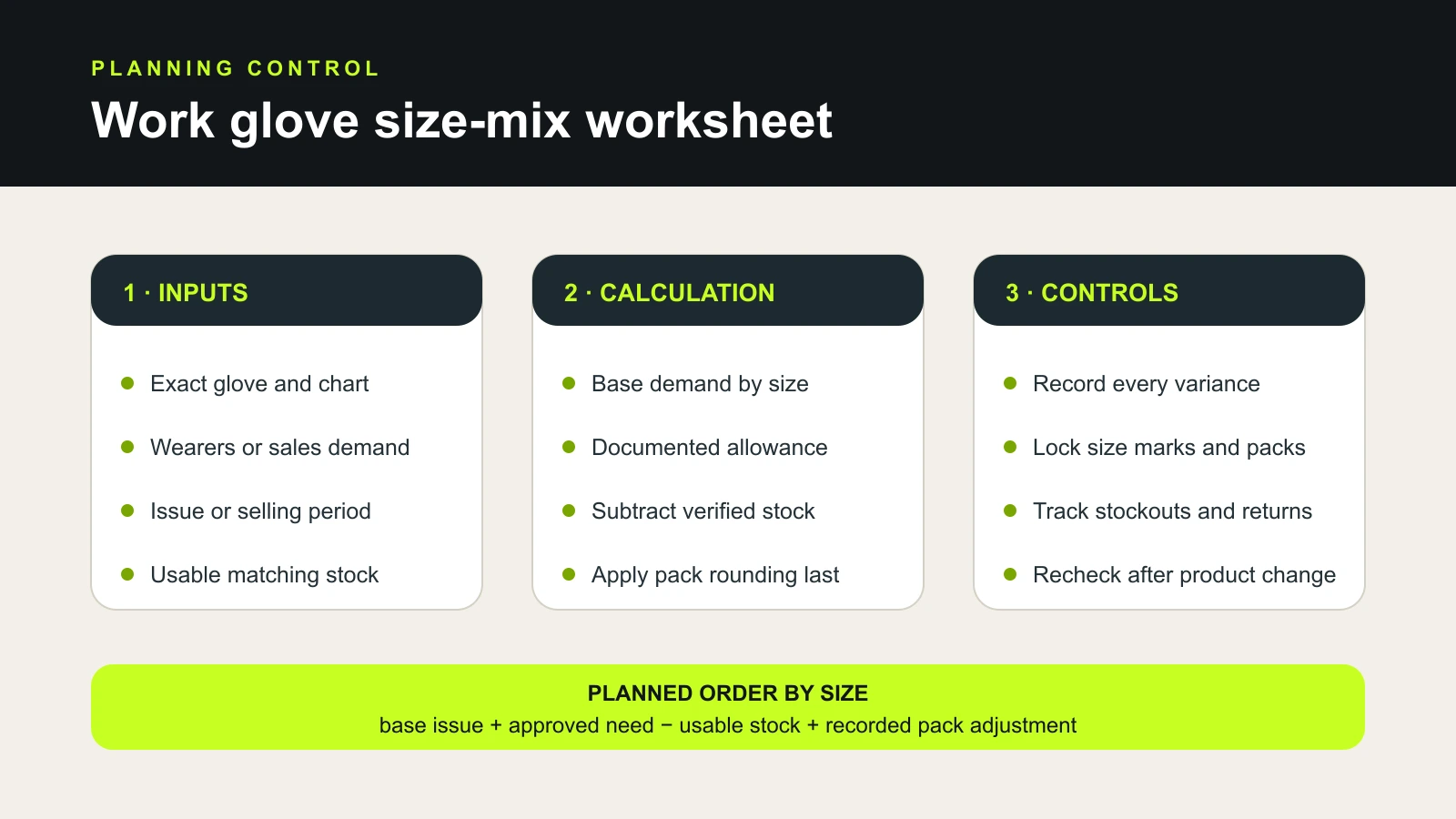
1. Base issue quantity. For each approved size, multiply the number of covered wearers by the planned pairs per wearer for the defined issue period. If issue frequency differs by role, calculate each role separately before combining the same size.
2. Known operational demand. Add documented onboarding, seasonal headcount, contractor or replacement needs by size where the buyer has a basis. Apply separate allowances when turnover or consumption differs by size.
3. Existing usable stock. Subtract verified stock that matches the same SKU, size definition and release condition. Similar-looking gloves or old size labels should not be counted as interchangeable inventory.
4. Pack rounding. Only after the demand is visible should the buyer round to the quoted inner-pack or carton multiple. Put the rounding variance in its own column.
The basic worksheet is:
planned order by size = base issue + approved operational allowance − usable matching stock + documented pack-rounding adjustment
This is not a supplier performance formula or a universal stock rule. Each input is controlled by the buyer's issue policy, workforce plan and inventory record.
Round packing without hiding a shortage
Packing can change the final quantities even when the measured mix is correct. Ask whether inner packs and cartons are single-size or mixed-size, what quantity applies to each size, and how each pack is marked. Then choose a rounding rule deliberately.
If rounding one size upward creates excess stock, keep it visible as excess. Reducing another size merely to preserve the original total creates a shortage unless the buyer accepts that change. A total of 1,000 pairs is not a complete order if the size-level quantities cannot be packed or if the needed sizes are not available.
A controlled purchase-order table can use these columns:
| Size | Measured or sales demand | Planned issue and allowance | Usable stock | Pre-pack requirement | Pack multiple | Final order | Rounding variance |
|---|---|---|---|---|---|---|---|
| Each offered size | Buyer data | Buyer policy | Verified stock | Calculated | Supplier quotation | Approved quantity | Recorded difference |
For private-label orders, keep size marks consistent across glove print, bag, label and carton. The private-label packaging guide can be used to separate artwork control from the quantity calculation. The supplier should quote any size-specific packing or minimum constraints rather than the buyer assuming they are identical.
Treat distributor demand differently from workforce issue
An end-user buyer normally knows the wearer population. A distributor has a market population and must infer demand from transactions. For distribution, build the mix by product, territory and channel; keep unrelated glove constructions separate even when they use the same letter sizes.
Review:
- Units sold by size and time period.
- Stockout days, because zero sales during a stockout are not zero demand.
- Returns or exchanges tied to fit.
- New accounts or channels not represented in historical sales.
- Seasonality and any change in the product or size chart.
- Slow stock that resulted from old assortment decisions rather than current demand.
Use a pilot quantity when the market is genuinely new. Mark it as a test and compare sell-through by size before setting the replenishment mix. The first order creates evidence; it does not create an eternal ratio.
Use issue and reorder data to correct the next size run
After release, track stockouts, substitutions, returns and leftover stock by size. A worker accepting a larger glove because the correct size was unavailable is a shortage signal, not proof that the larger size fits. Likewise, stock left at period end may reflect overbuying, low headcount or a task change.
At the next order review, compare planned versus actual use and write a reason for each adjustment. Keep the exact product identity and chart revision in the record. If the construction changes, repeat the fit check instead of carrying the previous ratio forward automatically.
The FENGAN order-control page shows where specification, sample, packing and acceptance decisions belong in the wider order process. Buyers comparing supplier offers can also use the coated work glove quotation checklist to keep size availability and quantity by size visible before comparing prices.
Send a size-ready RFQ
A supplier can respond faster when the RFQ separates product identity, total demand and allocation by size. Include:
- Exact glove construction, product code or reference sample.
- Target market, end-user or distributor use, and the intended issue or selling period.
- Current size chart used for the calculation and any fit exceptions.
- Quantity required for every size—not only a grand total.
- Whether quantities are pairs, inner packs or cartons.
- Required single-size or mixed-size packing and size-marking locations.
- Logo, bag, label and carton requirements where private label applies.
- Requested sample sizes and the users or channels they are meant to validate.
- Required destination-market standards and documents, if applicable to the exact order.
- Request for the supplier to identify size availability, pack multiples, size-specific constraints and every proposed substitution.
Buyers can start with the guide on how to specify coated work gloves for wholesale orders, then send the defined construction, quantities by size, packing brief and destination through the FENGAN RFQ form. The final size mix should be the buyer's traceable demand translated into a supplier-confirmed, packable order—not an unexplained percentage copied from another market.