
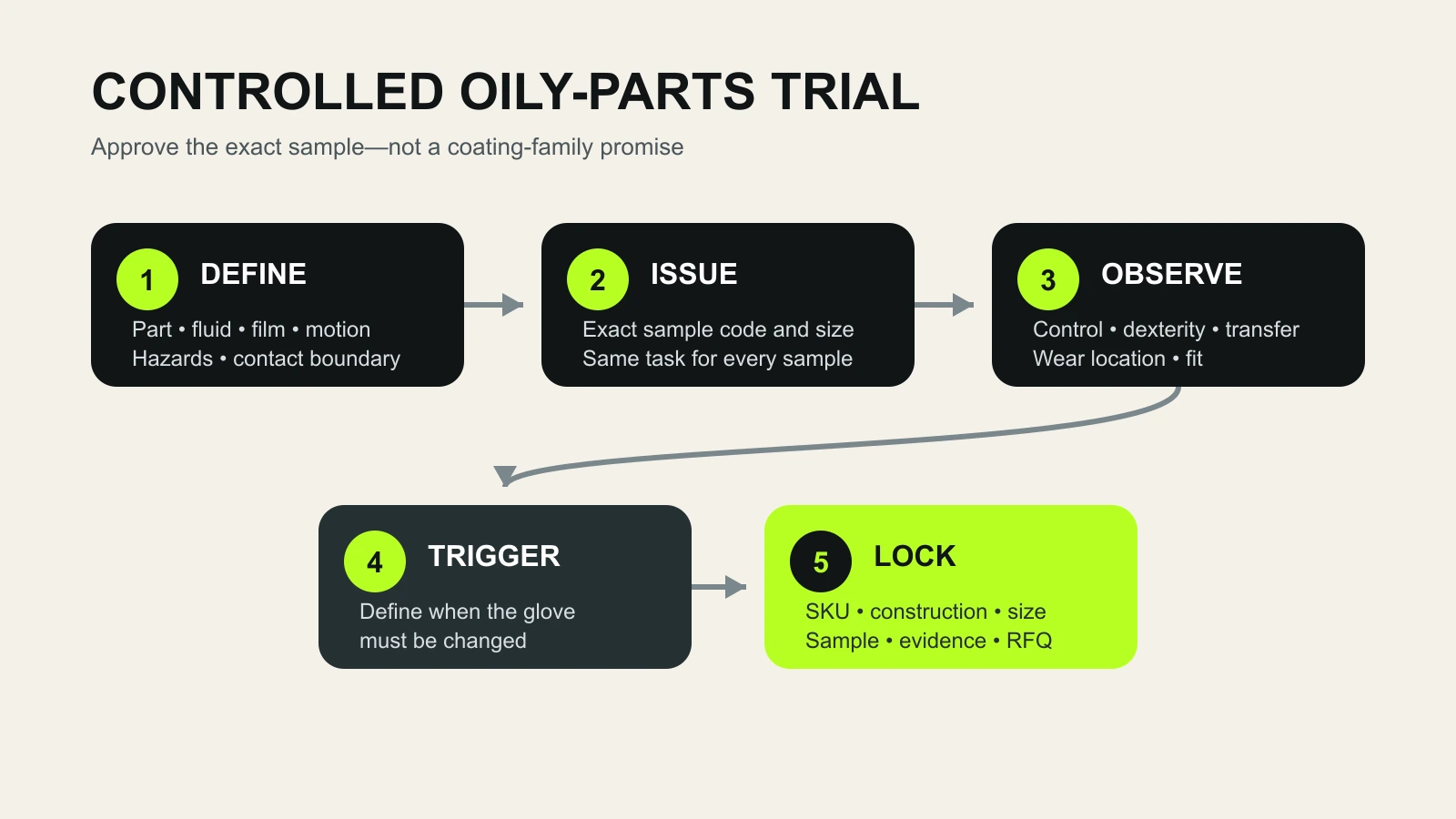
For oily-parts handling, avoid approving a glove from the words “nitrile coated” or “oil grip” alone. Name the oil or process fluid, define how much remains on the part, use the actual part and motion, issue the correct glove sizes, and run every sample under the same conditions. Record loss of control, dexterity, surface transfer, wear location and the point at which the glove must be changed. Then lock the exact construction and approved reference into the RFQ.
This is a handling trial, not a chemical-resistance test. A glove that helps an operator control a lightly oiled component may still be unsuitable for prolonged skin exposure, splash, immersion, cuts, punctures, heat or work near moving machinery. Those hazards need their own assessment and exact-SKU evidence.
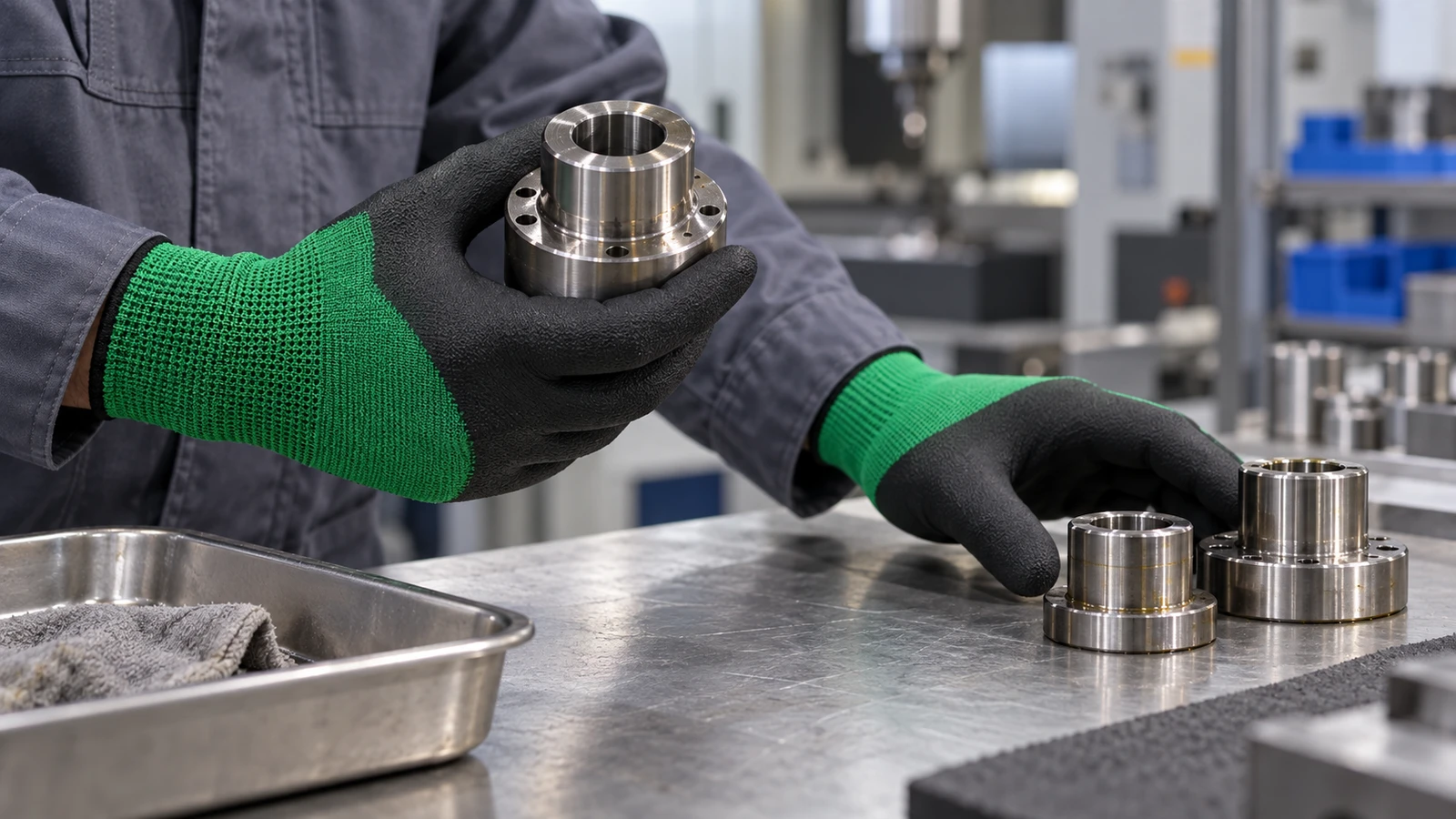
Define the oily-parts task before choosing a sample
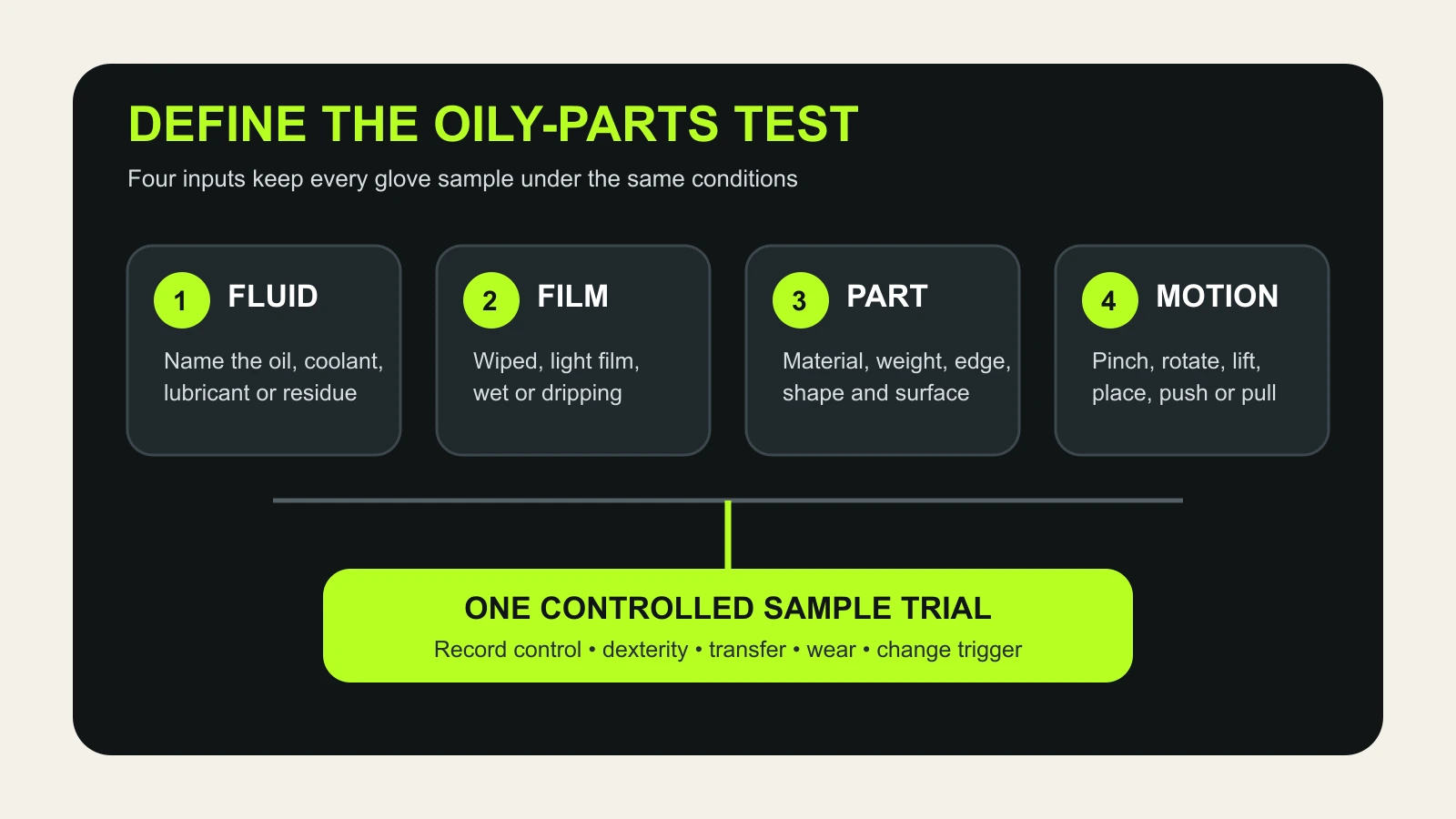
“Oily parts” is not one condition. A dry bearing with a fingerprint of protective oil, a machined shaft leaving a continuous film and a component dripping with cutting fluid present different handling and exposure questions. The first buying step is therefore a task profile, not a coating-family verdict.
Record these fields for each work zone:
- the oil, lubricant, coolant, cleaner or other substance by product name where known;
- whether the part is wiped, lightly filmed, visibly wet or dripping;
- the part material, mass, geometry, edges, temperature and surface texture;
- the hand motion—pinch, rotate, lift, place, push, pull, fasten or inspect;
- cycle time, repetition, wearing duration and the point in the shift when control usually changes;
- where the palm, fingertips, side of the hand, back of the hand and cuff may contact the part;
- identified mechanical, chemical, thermal and entanglement hazards;
- cleanliness requirements, including whether the glove may mark the finished part.
OSHA's hand-protection rule bases selection on performance characteristics relative to the task, conditions, duration and identified hazards. That is why a sample described only as “for oily work” is not ready for approval.
Use an exact construction as the starting sample
The FENGAN nitrile-coated glove range includes different finish and construction directions. They should be treated as separate sample definitions, because a finish name alone does not control liner, gauge, coating coverage, fit or production revision.
One exact starting candidate is the FG-NF01 foam nitrile coated glove:
| Specification field | FG-NF01 sample definition | What the buyer still has to verify |
|---|---|---|
| Liner | 15-gauge nylon/spandex seamless knit | Fit, hand movement, heat and comfort in the actual wearing period |
| Coating | Black microfoam nitrile | Control on the named fluid and part; chemical suitability is not established by the material name |
| Coverage | Palm and fingertips | Whether the task exposes the back of hand, wrist or cuff beyond this coverage |
| Quotation sizes | 7/S–12/3XL | Actual wearer distribution and size mapping |
| Approval role | Exact sample candidate | Grip observation, transfer, wear, change trigger and required test documents |
FG-NF01's construction makes it a reasonable item to include in a controlled trial; it does not prove a universal result on every oil or machined surface. If the buyer also wants smooth, textured or heavier alternatives, request them as separately identified samples and keep every result attached to its own SKU and revision. The existing foam-versus-smooth nitrile guide can help structure that comparison without turning either finish into an automatic winner.
Palm coating also has a clear boundary. The knit back is not a sealed liquid barrier, and palm coverage does not establish chemical protection for the hand. If the work involves splash, immersion or substance exposure rather than incidental film during handling, stop the general-purpose comparison and obtain compatibility data for the named substance and contact pattern.
Build one controlled sample trial
A useful trial changes one sample at a time while keeping the task stable. Avoid having one team test a wiped steel part and another test a dripping aluminum component, then comparing their opinions as though the coating were the only variable.
1. Set a baseline condition
Choose one representative part and prepare it using the normal work procedure. Record whether it is wiped or carries a visible film. If the fluid varies during production, create separate trial rows instead of averaging unlike conditions.
2. Issue the correct sizes
Poor fit can look like poor grip. A loose fingertip changes pinch control; a glove that is too tight changes movement and wearer acceptance. Use the actual worker size mix rather than one convenient sample size. The bulk-order size-mix guide explains how to build that distribution without assuming a universal ratio.
3. Repeat the real motion safely
Use the same pick, rotate, carry or placement cycle, at a safe test station and within the employer's safe system of work. Never introduce gloves near moving or rotating machinery simply to recreate production. If the job cannot be simulated safely, the employer must define another evaluation method.
4. Record observable handling results
Replace vague comments such as “good grip” with observations:
- Did the part rotate unexpectedly in the hand?
- Did the operator regrip before completing the motion?
- Could the operator place the part without overshoot or loss of alignment?
- Did fingertips retain enough control for fasteners, gauges or inspection tools?
- Did oil or soil transfer from the glove to a clean surface or finished part?
- Where did coating wear, polish, tear or separate first?
- Did the cuff, liner or uncoated area become contaminated?
The record should identify the operator, glove size, sample code, part, fluid condition, cycle and observation time. It should not invent a laboratory rating from a shop-floor test.
5. Define the change trigger
A buyer needs to know when the trial glove is no longer acceptable for the task. The trigger may be repeated loss of control, visible coating damage, contamination inside the glove, transfer to a finished surface, unacceptable fit change or another site-defined condition. Avoid converting a limited trial into a promised number of shifts or parts. Actual service life depends on the task and has to be measured locally.
6. Approve the reference, not the coating word
Keep the accepted glove, sample code, construction, size, date and sign-off record together. The coated work glove sample approval checklist provides the broader handoff from trial sample to production reference.
Use a decision table instead of a single grip score
One numeric grip score can hide a bad trade-off. A glove may feel secure on a large part yet reduce the fingertip control needed for a small fastener. Another may handle the part well at the start but transfer contamination after repeated cycles. Keep the decision fields separate.
| Decision field | Trial question | Approval evidence |
|---|---|---|
| Control | Can the operator complete the defined motion without unexpected rotation, slip or repeated regrip? | Observation against the same part, fluid film and cycle |
| Dexterity | Can the operator position, fasten or inspect without removing the glove? | Task result and operator note by size |
| Fit | Does the correct size keep fingertips, palm and cuff stable during the cycle? | Size-coded wearer record |
| Transfer | Does the glove leave oil, coating debris or soil where the process does not allow it? | Clean-surface or finished-part check defined by the buyer |
| Wear | Where does useful control change or visible damage begin? | Location, elapsed task period and condition photograph if permitted |
| Change trigger | What observable condition requires replacement? | Written site rule linked to the trial |
| Hazard evidence | What risks require certified or chemical data beyond the field trial? | Exact-SKU reports, markings and compatibility information |
This table helps procurement compare samples fairly. It does not replace the employer's risk assessment, a recognized test report or substance-specific compatibility data.
Separate oily handling from chemical protection
An oily surface may be a handling challenge, a skin-exposure issue or both. The distinction changes the evidence needed.
For incidental oil film on a part, a controlled handling trial can show whether the operator maintains useful control and dexterity. For repeated liquid contact, splash, immersion or a hazardous fluid, the buyer needs the substance identity, safety information, contact duration and compatibility data for the exact glove. HSE's glove-selection guidance emphasizes identifying the substance and using the correct manufacturer's data; no glove material protects against every substance indefinitely.
Avoid the following shortcuts:
- “Nitrile” means the glove is suitable for every oil or chemical.
- Palm coating means the whole hand is protected from liquid.
- A successful grip trial proves permeation resistance.
- A thicker glove automatically provides the right protection.
- A competitor's test report applies to the FENGAN sample.
If cut, puncture, heat or other mechanical hazards are present, ask for the appropriate evidence for the exact quoted construction. Those properties cannot be inferred from the coating finish or from a photograph.
Ask the supplier for a comparable sample set
Send the same task definition to each supplier. At minimum, request:
- exact product or sample code and revision;
- liner material and gauge;
- coating polymer, finish and coverage;
- sizes required for the wearer group;
- the named part, oil or process fluid and contact condition;
- the motion and wearing period used in the buyer's trial;
- documents required for the destination market and identified hazards;
- packing, labeling and private-label requirements;
- current MOQ and lead time for the exact quoted combination;
- a retained approval sample or other agreed production reference.
Use the quotation comparison guide to keep construction, documents, packing and commercial terms aligned. A lower price for an unspecified “nitrile glove” is not directly comparable with a quotation tied to an exact liner, finish, coverage, size run and approved sample.
RFQ checklist for oily-parts applications
Before sending the inquiry, confirm that the RFQ answers these questions:
- What part is handled, and what makes its surface difficult to control?
- Which oil, coolant, lubricant or residue is present?
- Is the condition wiped, lightly filmed, visibly wet, dripping, splash or immersion?
- Which motion and cycle must the glove support?
- Which glove areas contact the part or substance?
- What size range and wearer distribution are required?
- What control, dexterity, transfer, wear and change-trigger observations decide approval?
- Which mechanical, chemical, thermal or market-compliance documents are required?
- Which packing, labeling and private-label variables belong in the quotation?
- How will the approved sample be identified and retained?
FENGAN's order-control process can be used as the commercial handoff after the buyer defines these inputs. To discuss a controlled sample set, send the part, named fluid, film condition, motion, size range, target market and required documents through the FENGAN RFQ form. The goal is not to promise one glove for every oily task; it is to quote and approve one exact construction against one defined job.