
Choose coated work gloves by starting with the actual task: what the worker touches, how the hand moves, which hazards are present, how long the glove is worn and what conditions surround the job. Turn those observations into a complete construction—liner, gauge, coating family, finish, coverage, cuff and size—then compare samples under controlled working conditions. A coating name by itself is never a complete buying specification.
For an importer or distributor, this process has two outputs. The first is a glove that workers can evaluate for fit and handling. The second is a written RFQ that lets suppliers quote the same construction and provide evidence for the exact target market.
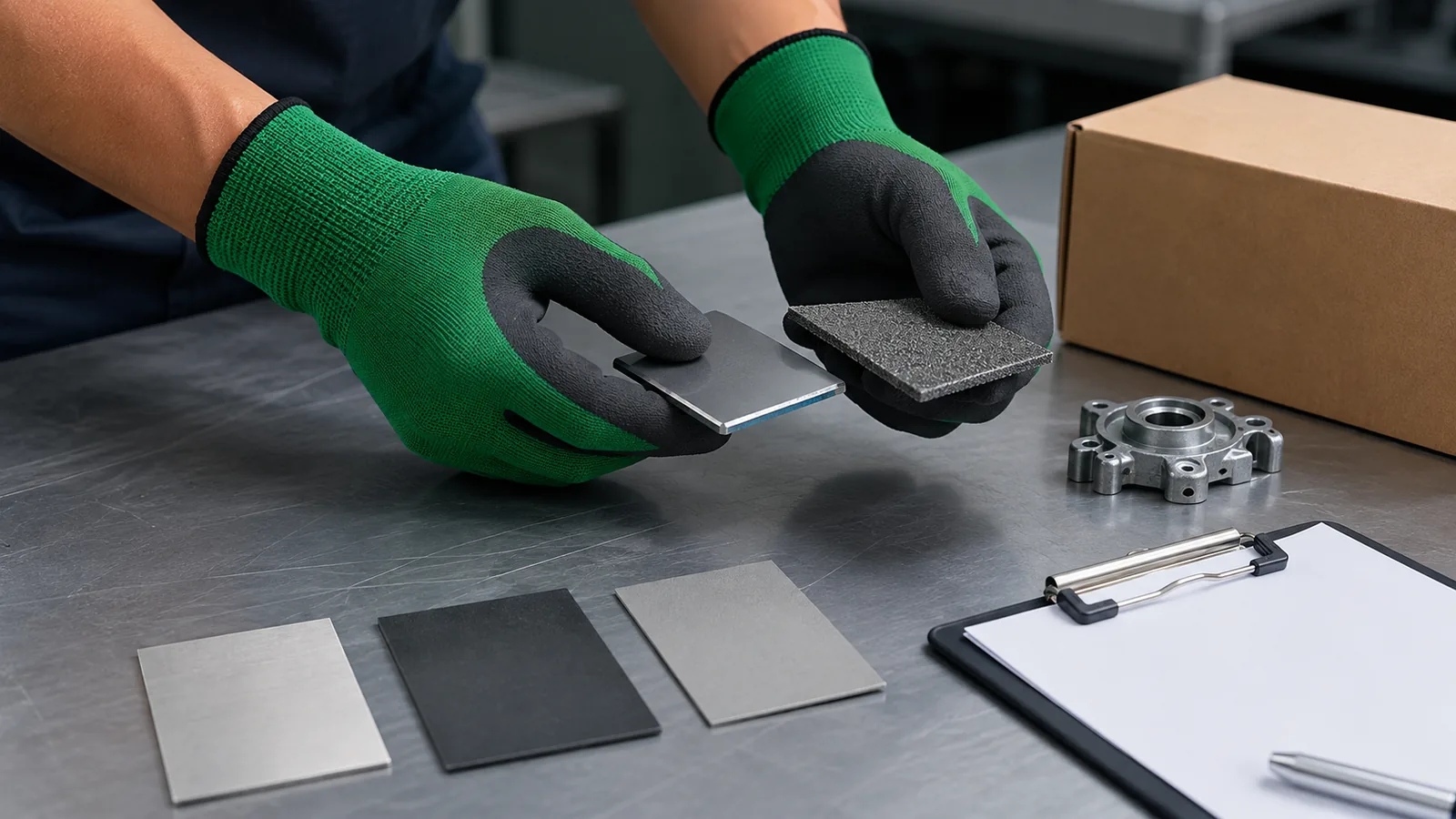
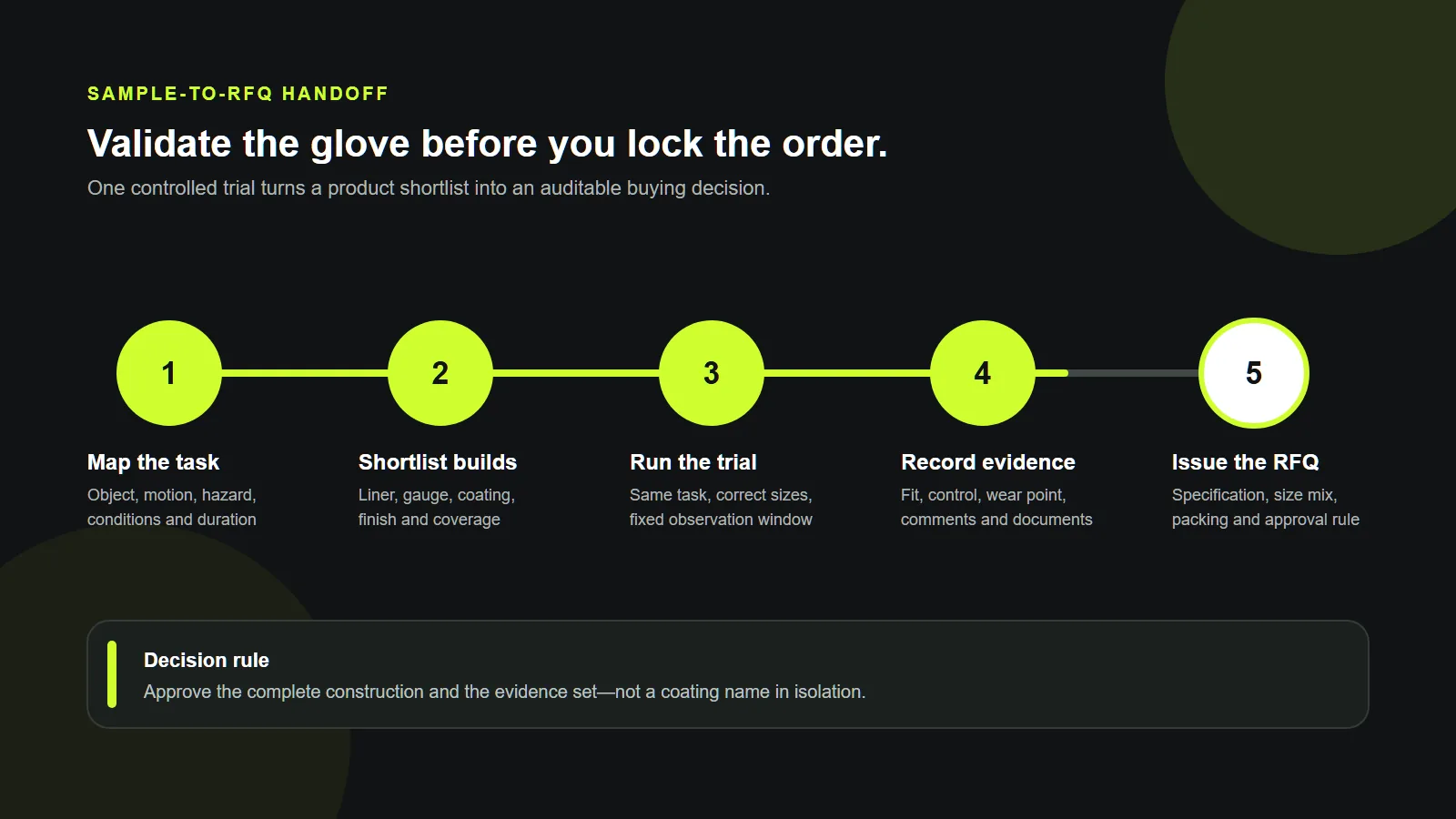
The five-step coated glove selection process
- Map the task, hazards, contact surface, environment and wearing time.
- Decide which construction variables need to change: liner, gauge, coating, finish, coverage, cuff and size.
- Shortlist two or three complete glove constructions rather than isolated materials.
- Test correctly sized samples during representative work and record the result.
- Convert the approved sample into a controlled RFQ, purchase specification and inspection reference.
This order matters. Starting with a product catalogue encourages buyers to choose by color, price or a familiar coating name. Starting with the work makes it easier to separate a reasonable shortlist from a product that needs a different protection category altogether.
Start with the task and hazard, not the coating
For United States workplaces, OSHA’s hand-protection rule says selection should evaluate a glove’s performance characteristics against the task, conditions, duration of use and identified hazards. The principle is useful for international procurement even when another jurisdiction or standard applies: define the exposure before selecting the product.
Walk through the task and record what actually happens to the hand:
- What object is handled: clean cartons, rough castings, oily components, sheet edges, small fasteners or tools?
- What motion repeats: lifting, pinching, rotating, pushing, pulling, fastening or inspection?
- Which part of the glove contacts the object: fingertips, palm, side of the hand, back of the hand or wrist?
- Are the surfaces dry, lightly oily, wet, dusty, hot, cold or contaminated by a named chemical?
- How long is each contact, how often is it repeated and how many hours is the glove worn?
- Which hazards need verified performance: abrasion, cut, puncture, impact, heat, cold, chemical contact or another risk?
These questions may reveal that a general coated knit glove is only part of the answer. Sharp edges, chemical exposure, extreme temperature, electrical work or other defined hazards can require specific materials, designs and test evidence. The facility’s hazard assessment and applicable rules remain the starting point.
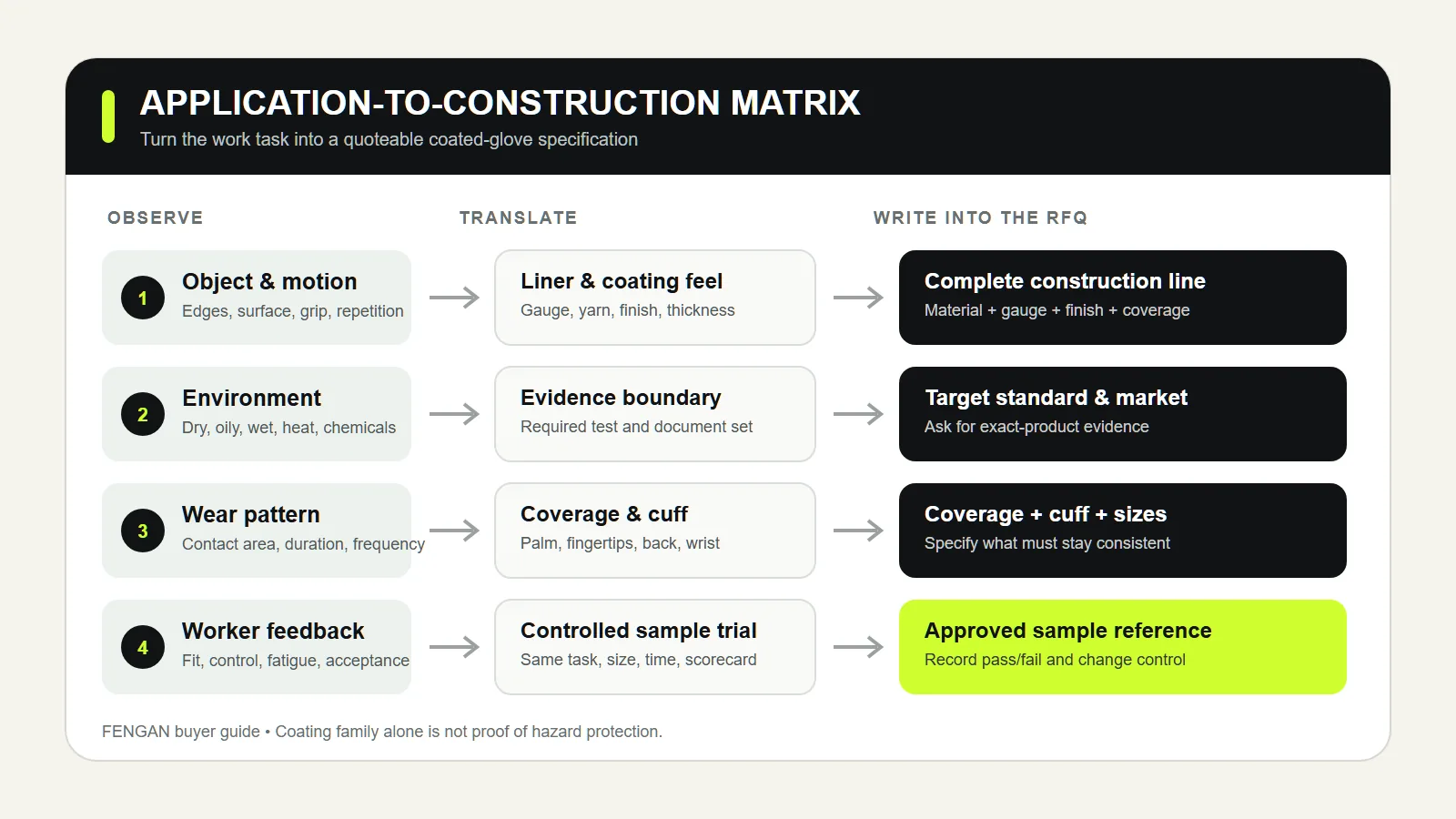
Translate the work into a complete glove construction
A coated glove is a system. The liner controls the base fit and hand feel. The coating changes the contact surface. Finish and thickness affect how that surface behaves. Coverage determines where coating is present. Cuff, size and hand shape influence stability and wearer acceptance.
Use the following table to keep the buying conversation specific.
| Selection field | What to observe at work | What to write in the shortlist |
|---|---|---|
| Object and motion | Surface texture, part size, edges, grip direction and repeated movement | Representative task and handled item |
| Hazard and evidence | Identified hazard, required standard and destination market | Required rating or document for the exact construction |
| Liner | Bulk, stretch, seam-free feel, fiber needs and wearing time | Yarn composition, seamless knit and gauge |
| Coating | Contact condition and required handling feel | Coating family and formulation description supplied for the sample |
| Finish | Smooth, foam, crinkle or textured contact surface | Exact finish name and approved visual reference |
| Coverage | Areas that touch the work or need a barrier | Fingers, palm, knuckles, back and cuff coverage |
| Fit and sizes | Finger length, palm width, cuff stability and workforce range | Size range, measurement method and planned size mix |
| Order controls | Branding, packing, documents and repeat-order consistency | SKU/sample ID, artwork, packing and approval record |
The existing guide to specifying coated work gloves for wholesale orders provides a broader purchase-specification format. The selection stage described here feeds that document with evidence from the task and sample trial.
Compare coating families as shortlists, not guarantees
FENGAN organizes its current range into nitrile coated gloves, latex coated gloves, PU coated gloves and PVC coated gloves. That family name helps narrow the catalogue, but the quotation still needs the exact finish, coverage, liner and intended use.
Nitrile-coated constructions
The FENGAN nitrile range includes foam, smooth, heavy, standard and textured options. Buyers often shortlist a foam or textured construction when handling feel in dry or lightly oily work is important, but that is a sampling hypothesis rather than a universal result. Oil type, contamination level, coating formulation and the object’s surface can change the outcome.
FG-NF01 Foam Nitrile Coated Work Gloves provide one exact example: a 15-gauge nylon/spandex liner with microfoam nitrile on the palm and fingertips. It can serve as a starting sample for assembly, warehouse, tool-handling or inspection tasks where this construction fits the hazard assessment. Its product description is not evidence for every nitrile glove or every oily environment.
When comparing foam and smooth options, use the existing foam versus smooth nitrile guide to identify what belongs in the trial rather than treating the finish name as a verdict.
Latex-coated constructions
FENGAN’s latex range includes crinkle, foam and textured palm-coated options, plus additional constructions that require their own exact review. A buyer can shortlist latex when the task calls for the hand feel and surface profile of a chosen sample, especially for rough or irregular objects. The actual result still depends on finish, coating thickness, liner, fit and the work surface.
Personnel sensitivity to natural rubber latex also belongs in the workplace assessment. Where it is relevant, confirm material information and the employer’s control requirements before approving the construction.
The latex crinkle versus foam latex guide explains why two gloves inside the same family can feel different. The lesson is broader than latex: finish should appear in the RFQ and on the approved sample record.
PU-coated constructions
PU-coated gloves are commonly considered when buyers want a close-fitting construction for clean handling, inspection or light assembly. In the FENGAN range, palm-coated and finger-coated options are separate products. Coverage must therefore be stated explicitly, particularly when fingertip control and contamination of handled parts matter.
A thin-feeling sample can support dexterity, but neither PU nor a fine gauge proves mechanical protection. If cut, abrasion, puncture or another rating is required, request the current test evidence for the exact liner-and-coating combination.
PVC-coated constructions
PVC is another available coating family, but its useful form depends on coverage, finish, liner and cuff. A fully coated gauntlet-style construction and a palm-coated knit glove should never share one image, specification or application claim. At the selection stage, describe the exposure and barrier area first, then evaluate an exact sample and its supporting documents.
Finish, coverage and gauge can change the result inside one family
Two nitrile-coated gloves may differ more from each other than a catalogue heading suggests. One may use a smooth palm coating, another a foam surface, and another a heavier or textured finish. Each option changes the contact interface and can change flexibility, liquid interaction and perceived grip.
Coverage creates another boundary. Palm-and-fingertip coating leaves the back of the hand different from a fully coated construction. Extra coverage may be relevant to the exposure, while it may also change flexibility, ventilation and weight. The guide to palm-coated versus fully coated work gloves helps buyers describe that decision without turning coverage into an unsupported performance claim.
Liner gauge is similarly incomplete on its own. A higher gauge generally indicates a finer knitted liner, but yarn, coating mass and fit shape can change the finished feel. Compare the whole construction and use the 13-gauge versus 15-gauge buyer guide when gauge is a key quotation variable.
Fit and size mix belong in the selection decision
One sample size cannot represent an entire workforce or a complete wholesale order. A glove that is too large can leave excess fingertip material and reduce control. A glove that is too tight can restrict movement, create pressure points or discourage continued wear. Cuff tension and glove length matter as well.
Evaluate sizes on the people who perform the task. Record finger length, palm width, ease of donning, cuff stability and any movement restriction. Then build the order’s size mix from actual workforce or customer data rather than a universal ratio.
Fit should be checked again when the liner yarn, gauge, coating thickness or pattern changes. A familiar nominal size may feel different after a construction change, so the revised sample needs its own approval.
Require evidence that matches the exact glove
Coating material should never stand in for a test report. A nitrile name does not prove chemical resistance. A textured surface does not prove a grip rating. A liner described as strong does not prove cut protection. A full coating does not automatically prove waterproof performance.
OSHA’s nonmandatory PPE selection guidance notes that no glove protects against every hand hazard and recommends assessing performance for the specific hazard. It also advises purchasers to request documentation that the glove meets the appropriate test standard for the anticipated hazard.
For B2B sourcing, connect each required claim to four identifiers:
- The exact product or sample reference.
- The full liner, coating, finish and coverage construction.
- The applicable test method or destination-market document.
- The issue date, report reference and model information supplied for review.
If the quotation changes a material or structural variable, confirm whether the evidence still applies. A similar-looking glove or a report for another SKU is not a reliable approval basis.
Run a controlled sample trial
A useful trial compares a small number of plausible constructions under the same conditions. Give each participant the correct size and ask them to perform representative motions with the actual or safely simulated object. Keep the observation window consistent enough to compare feedback.
Record objective and subjective findings separately.
Objective observations can include coating coverage, visible finish consistency, fingertip alignment, seam or knit defects, cuff position, measured dimensions, pair weight for the same size, visible wear location and the condition after the defined trial.
Worker feedback can include control, tactile feel, comfort, heat buildup, pressure points, slippage inside the glove and whether the glove interfered with the motion. Feedback is valuable for acceptance, but it does not replace a required laboratory test.
The trial should also record failures. If a glove loses control on a representative surface, creates unacceptable bulk or wears in an unexpected area, document the task and condition. That evidence helps the supplier propose a different finish, coverage or liner without guessing.
Convert the approved sample into an RFQ
A quote-ready coated glove RFQ should contain:
- Application, handled object, repeated motion and expected wearing time.
- Working conditions, named contaminants and identified hazards.
- Required standard, rating or documentation for the destination market.
- Liner material, gauge and any yarn requirement.
- Coating family, exact finish, thickness or weight control when applicable, and coverage.
- Cuff style, color, size range and expected size allocation.
- Approved sample code, photographs and trial record.
- Logo position, colors and artwork file.
- Inner packing, labels, barcode fields, carton details and shipping marks.
- Estimated quantity and requested quotation options.
- Rules for approving any later material, construction or packing change.
The FENGAN order-control process connects the specification, sample, artwork, packing and pre-shipment checks. Keeping those items in one approval file reduces the risk of evaluating a good sample while purchasing a differently described bulk product.
Common mistakes when choosing coated work gloves
Choosing one “best” coating for every department
Different tasks can involve different objects, hazards, motion and wearing time. A facility-wide catalogue shortcut may create poor fit in one department and insufficient evidence in another. Group jobs by exposure and motion before standardizing the glove.
Comparing prices before normalizing the construction
Two prices are not comparable when liner, gauge, coating finish, coverage, size mix or packing differs. Align the specification first, then compare the commercial offer.
Treating worker preference as a protection rating
Comfort and handling feedback support wearer acceptance. Formal protection requirements need the relevant test evidence. Keep both in the decision record without confusing their roles.
Approving only the glove and forgetting packaging
Private-label orders also depend on logo, size marks, cards, bags, labels and cartons. Link the approved product sample to the approved artwork and packing records before production.
Allowing substitutions without a new review
A changed yarn, gauge, coating formulation, finish or coverage can create a different glove. Define which changes trigger a new sample or document review.
A practical final decision rule
The right coated glove is not the one with the most attractive material name or the lowest unit price. It is the complete construction that fits the assessed task, carries the required evidence, works across the needed size range and passes a representative sample trial.
Start with the full FENGAN coated work glove range, compare only constructions that fit the application, and keep the approved sample connected to the written specification. To request a structured quotation, send the application, target market, quantity, size mix, coating and packing requirements through the FENGAN RFQ form.