
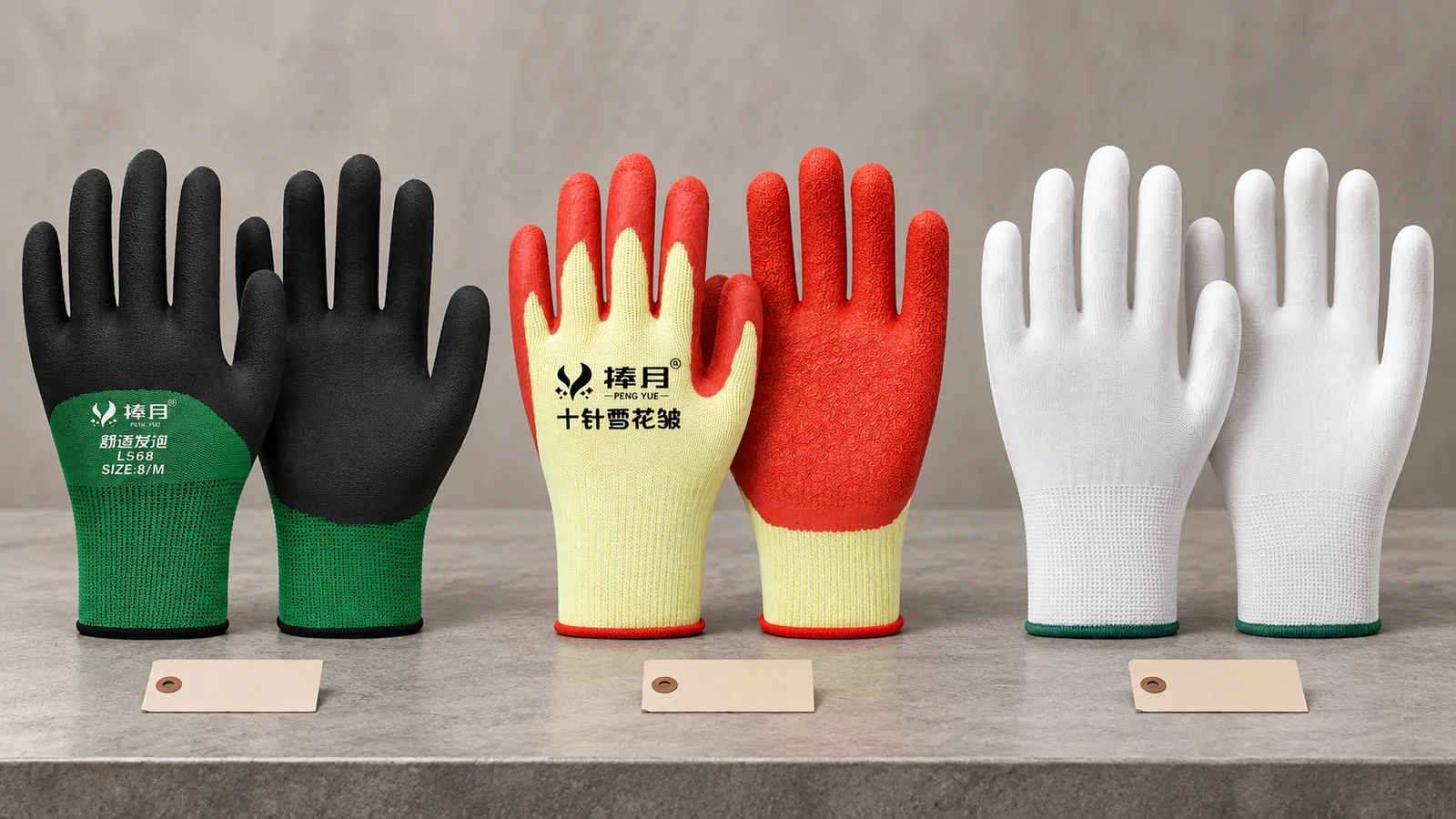
When comparing nitrile vs. latex vs. PU coated work gloves, the coating name alone is not enough for a decision. Shortlist complete constructions, issue the correct sizes, and test them on the same parts under the same work conditions. A practical three-sample set can include one microfoam nitrile palm-coated glove, one crinkle latex palm-coated glove and one smooth PU palm-coated glove. Record control, dexterity, fit, wear location and worker acceptance, then lock the exact construction and approved sample into the RFQ.
The result may differ by task zone. A receiving team handling cartons, an assembly cell positioning small components and a yard crew moving rough materials may not need the same glove. Coating family is only one variable alongside finish, coverage, liner, gauge, size and cuff. Hazard protection, chemical suitability and certification must be verified for the exact glove; they cannot be inferred from “nitrile,” “latex” or “PU.”
Start with the task, not a winner
Search results often reduce this comparison to a simple winner: nitrile for one condition, latex for another and PU for a third. That shorthand can help create a shortlist, but it is too broad for a purchase specification. Two gloves with the same coating family can differ in surface finish, coating thickness, palm coverage, liner yarn, gauge, size and fit. Those changes can alter what the worker actually feels and how the glove behaves in the job.
The safer buying question is: which complete glove construction performs acceptably in this defined task and hazard assessment? OSHA's hand-protection rule requires selection to consider performance characteristics relative to the work, conditions, duration and identified hazards. The UK's HSE glove-selection guidance likewise emphasizes the work, wearer and environment, and notes that no glove material protects against every substance.
That matters for a wholesale order because a coating comparison is not automatically a protection comparison. A routine field trial can help assess handling and wearer acceptance. It does not establish chemical permeation, cut, puncture, thermal, waterproof or certification performance. If any of those are required, ask for the relevant report and marking for the exact quoted SKU and confirm that the document applies to the intended market.
Build a three-construction shortlist
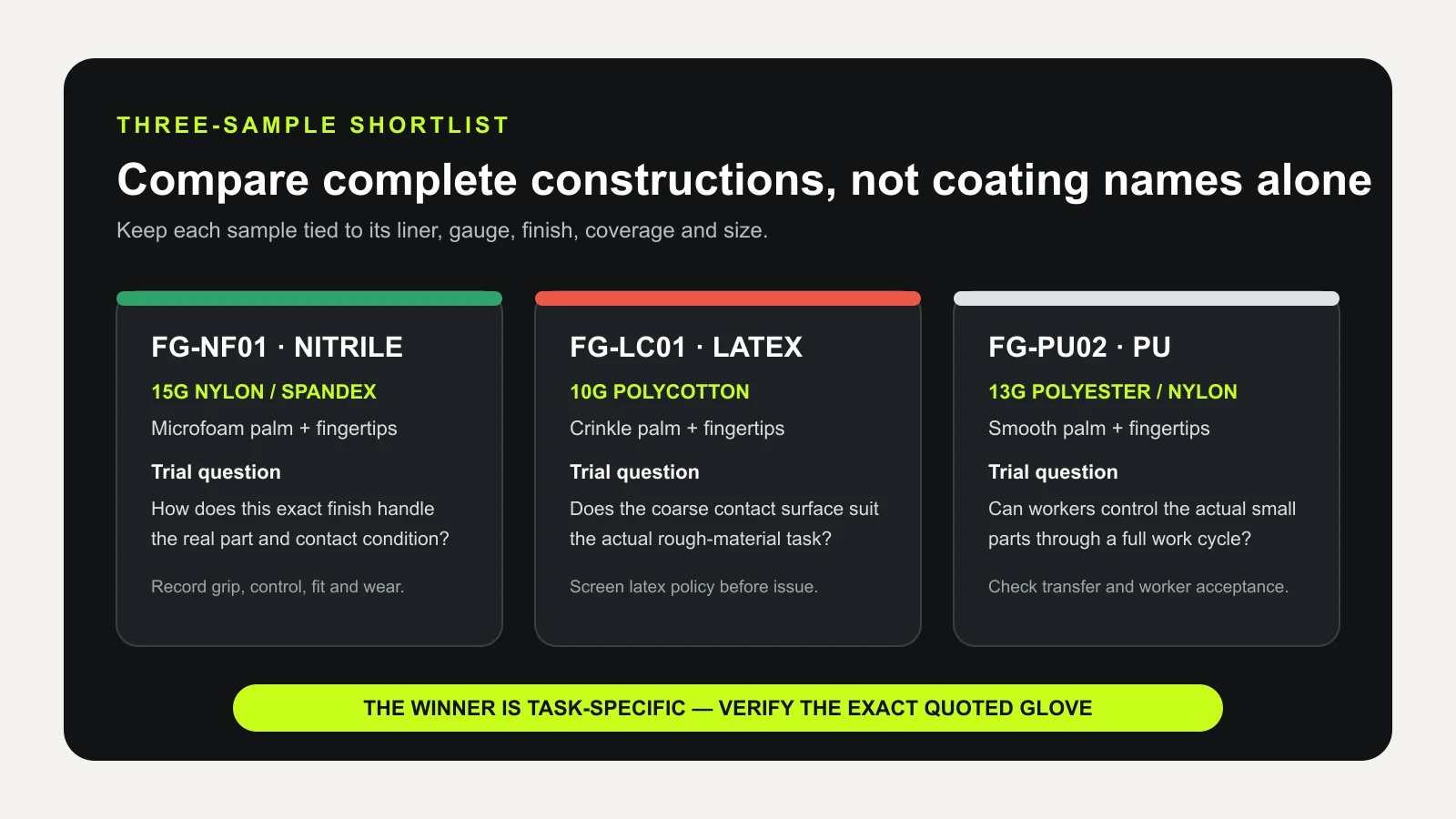
FENGAN's current range provides three approved visual and specification anchors that can be sampled as separate constructions. They are not interchangeable representations of every nitrile, latex or PU glove.
| Sample | Exact construction used for the comparison | Useful first task hypothesis | What must remain open until trial or documentation |
|---|---|---|---|
| FG-NF01 foam nitrile coated glove | 15-gauge nylon/spandex seamless knit; microfoam nitrile on palm and fingertips; quotation sizes 7/S–12/3XL | Candidate for buyers balancing tactile handling with a dry or lightly oily contact profile | Actual grip on the buyer's part, wear rate, size fit, and any required protective performance |
| FG-LC01 latex crinkle coated glove | 10-gauge polycotton seamless knit; crinkle latex on palm and fingertips; quotation sizes 7/S–12/3XL | Candidate for rough-material handling where a coarse contact surface is worth testing | Actual control, snag or wear behavior, worker acceptance, latex policy, and any required protective performance |
| FG-PU02 PU palm coated glove | 13-gauge polyester or nylon seamless knit; smooth PU on palm and fingertips; quotation sizes 6/XS–12/3XL | Candidate for dry precision handling and small-part control | Actual transfer, wear, fit, dexterity and any required protective performance |
These samples intentionally differ in more than polymer. The 15-gauge nylon/spandex liner in FG-NF01, 10-gauge polycotton liner in FG-LC01 and 13-gauge polyester-or-nylon direction in FG-PU02 create a comparison of three real product constructions. The trial must record those differences rather than attributing every result to the coating.
Natural rubber latex also needs a wearer-policy check before samples are issued. HSE identifies natural-rubber-latex proteins as an occupational allergy concern and recommends that employers consider the wearer as part of glove selection. That does not automatically disqualify every latex-coated work glove, but it means a procurement team should not run a latex trial without the employer's risk assessment and user controls.
Map the job before samples arrive
A useful sample trial begins with a one-page task map. If the work is described only as “warehouse,” “assembly” or “construction,” the trial will produce vague opinions instead of a buying decision.
Record the following for each task zone:
- the part or material being held, including its shape, edge and surface texture;
- whether the contact surface is dry, dusty, damp, lightly oily or exposed to another named substance;
- the main hand motions: carrying, pinching, rotating, pushing, pulling or positioning;
- the size and weight range of the handled items;
- how long one work cycle and one wearing period last;
- where gloves usually wear, snag, become contaminated or lose useful control;
- the sizes required by the actual wearer group;
- identified mechanical, chemical, thermal or other hazards and the evidence required for them;
- compatibility needs such as sleeves, cuffs, touch points or product-cleanliness controls.
Split materially different jobs into different rows. A glove that is acceptable for carton handling should not automatically pass for a station handling sharp edges or an unidentified chemical. If a chemical is present, use the chemical's safety information and exact manufacturer compatibility data; a general coating-family article is not a chemical-selection chart.
The task map should end with a short acceptance question. For example: “Can correctly sized operators pick, rotate and place this component for one representative cycle without repeated slips or unacceptable loss of control?” This is more useful than “Which glove feels best?” because it creates something observable.
Keep the sample trial comparable
Use the same task definition for all three samples. A new glove used by one experienced operator on a clean morning shift is not comparable with another glove used by a different operator near the end of a contaminated shift.
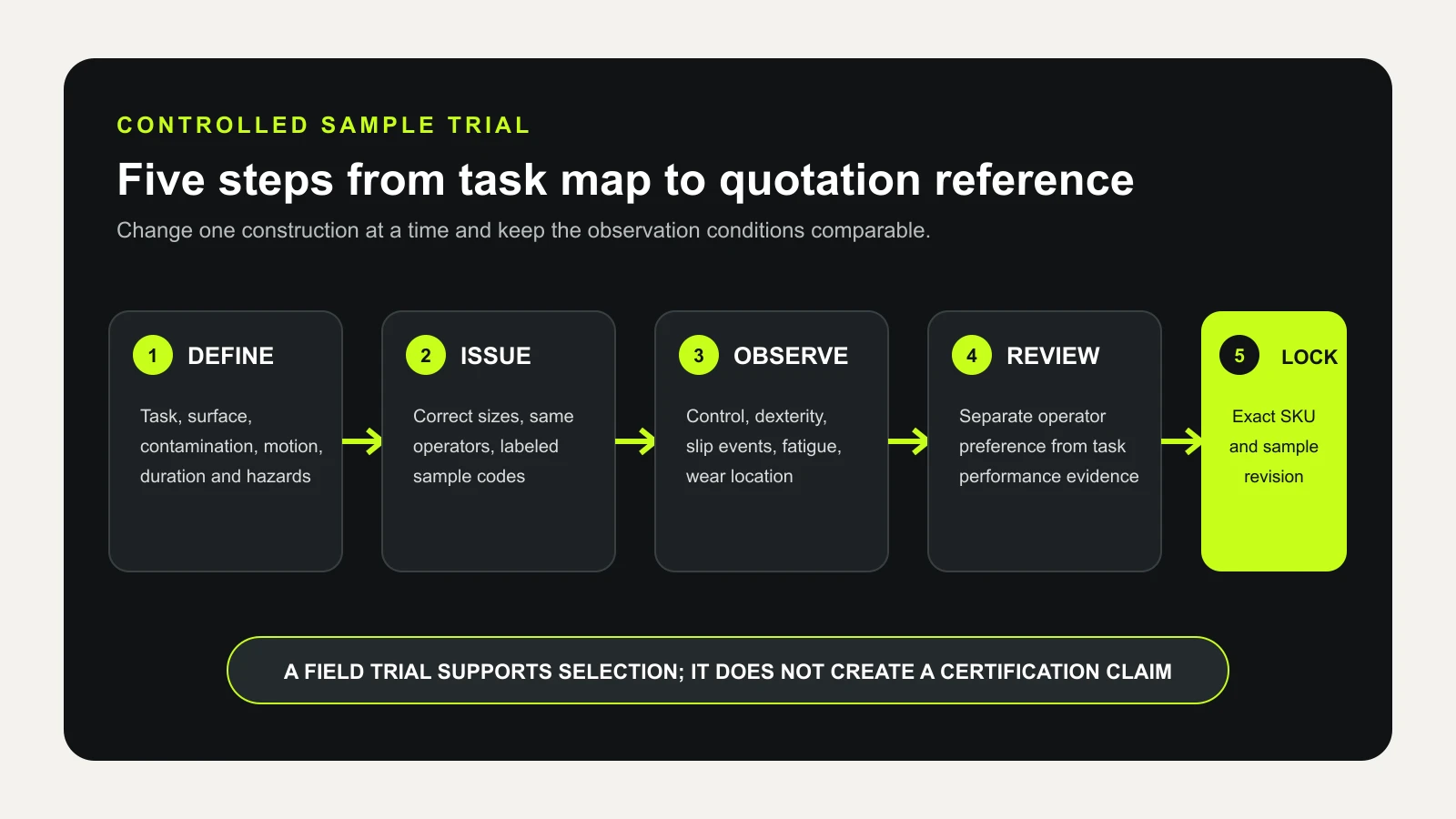
A controlled buyer trial can follow five steps:
- Define the task and stop conditions. State the surface, contamination, motion, duration and hazards. Stop the trial if an unaddressed hazard appears or if the glove is damaged in a way that could affect safe handling.
- Issue correct sizes and labeled samples. Record the SKU, sample revision, size and issue date. Treat a poor size match as a sizing problem rather than hiding it inside a material comparison.
- Use representative work cycles. Keep the part, process and observation window as consistent as practical. If multiple shifts or operators are included, record them separately.
- Capture observations, not slogans. Note where control changed, which motions became harder, where wear appeared and why an operator accepted or rejected a sample.
- Review and lock the reference. Select the exact construction for each task zone, then retain a signed or otherwise controlled approval sample and written specification.
Score what buyers can actually observe
The trial form should make different reviewers record the same kinds of evidence. Use a simple scale only after defining what each point means. A number without a visible observation is difficult to use in supplier comparison or later inspection.
| Observation field | What to record | Why it helps the purchase decision |
|---|---|---|
| Fit by size | Loose fingertips, pressure points, cuff behavior and whether the glove stays positioned | Separates sizing problems from coating or liner judgments |
| Initial part control | Which motion or surface produces a slip, regrip or secure hold | Connects the result to the actual contact condition |
| Fine manipulation | Ability to pick, align, fasten or release the real component | Shows whether the full construction supports the required motion |
| Hand effort and fatigue | Where extra grip force or repeated adjustment is needed | Identifies a productivity or acceptance issue without making a medical claim |
| Contamination behavior | Visible transfer, loading or change in surface feel during the cycle | Helps determine whether the task needs another finish or cleaning/replacement rule |
| Wear location | Abrasion, peeling, cracking, puncture, seam or liner damage and when it appears | Provides a location-based reason to review construction or hazard evidence |
| Worker acceptance | Specific reason for acceptance or rejection | Prevents “comfortable” or “bad” from becoming the entire evaluation |
| End-of-trial disposition | Continue, retest, reject or request documentation | Keeps an inconclusive trial from being treated as an approval |
Photograph wear areas with the sample code visible, while keeping an informal field trial separate from a laboratory rating. A few operators and work cycles can help narrow the choice; they cannot prove service life across every facility, worker or batch.
Decide whether one glove can cover every task zone
Standardizing one SKU may simplify purchasing, training and inventory, but only if that glove meets the requirements of each included task. Start with the shared task conditions, then look for the exception that breaks the standard.
For example, a buyer may find that one construction is accepted across general handling cells but not at a precision station. That does not mean the coating family “failed.” It may mean the liner, gauge, fit or finish is mismatched to one motion. Conversely, adopting several similar gloves without clear task ownership can create picking errors and fragmented order quantities.
Use this decision order:
- Group task zones with genuinely similar parts, contamination and hand motions.
- Identify the highest-evidence requirement in each group.
- Test the same shortlisted constructions within that group.
- Standardize only where the recorded result supports it.
- Assign a separate SKU where a meaningful requirement remains different.
The broader FENGAN coated work glove range separates nitrile-coated gloves, latex-coated gloves and PU-coated gloves. Use those families to expand the shortlist only when the task map shows what needs to change. If the difference is within one family—such as foam versus smooth nitrile—compare the exact finish rather than restarting with another broad material label.
Convert the selected sample into an approval record
Once a preferred glove is identified, the sample must become a controlled commercial reference. “Same as the sample we liked” is not enough for a repeatable quotation.
The approval record should include:
- supplier SKU and buyer SKU;
- sample revision, issue date and approval date;
- liner material and gauge;
- coating family, finish and coverage;
- cuff construction and colorway;
- approved sizes and the proposed size mix;
- visible marking, logo placement and artwork revision if private label is required;
- pack format, label and carton references;
- required test reports, declarations or market documents for the exact glove;
- agreed inspection points and any written tolerances;
- the task zones and trial record supporting selection.
Keep hazard evidence separate from the buyer's field observations. If the application requires a particular EN, ANSI, chemical, thermal or other performance level, that requirement belongs in the specification and must be supported by valid evidence for the quoted construction. Neither a generic coating guide nor the buyer's handling trial can substitute for that proof.
For a more detailed handoff, use the coated work glove sample approval checklist and connect the approved reference to FENGAN's order-control process.
Send an RFQ that preserves the comparison
After the trial, request quotations against the same controlled input. If one supplier quotes FG-NF01-like microfoam nitrile and another quotes an unspecified “nitrile glove,” those prices represent different product definitions.
Include these fields in the RFQ:
- task zone and handled material;
- named contact condition and wearing duration;
- exact sample or target SKU;
- liner material, gauge, coating, finish, coverage and cuff;
- colors and approved size range;
- quantity by size, not only total pairs;
- destination market and required documents;
- logo, artwork and packaging scope;
- approval-sample process and revision control;
- inspection criteria and evidence requested;
- replacement or retest conditions if the production sample differs;
- target order timing, with the supplier confirming current MOQ and lead time.
Then use the quotation comparison guide to align exclusions, packing, evidence and commercial assumptions. Unit price alone is not a sound award basis when the offered constructions or approval controls differ.
The practical answer
There is no universal winner in a nitrile, latex and PU coated work glove comparison. The defensible choice is the exact construction that passes the buyer's task map, wearer review, hazard requirements and controlled sample process. Start with three clearly different, correctly sized samples; observe the same work; record why each option succeeds or fails; and keep any certification or protection claim tied to the exact quoted glove.
If you are preparing a bulk comparison, send FENGAN the handled material, contact condition, work motion, required sizes, destination market and documentation needs. Use the FENGAN RFQ form to request a three-construction sample discussion and a quotation built around the same recorded requirements.