
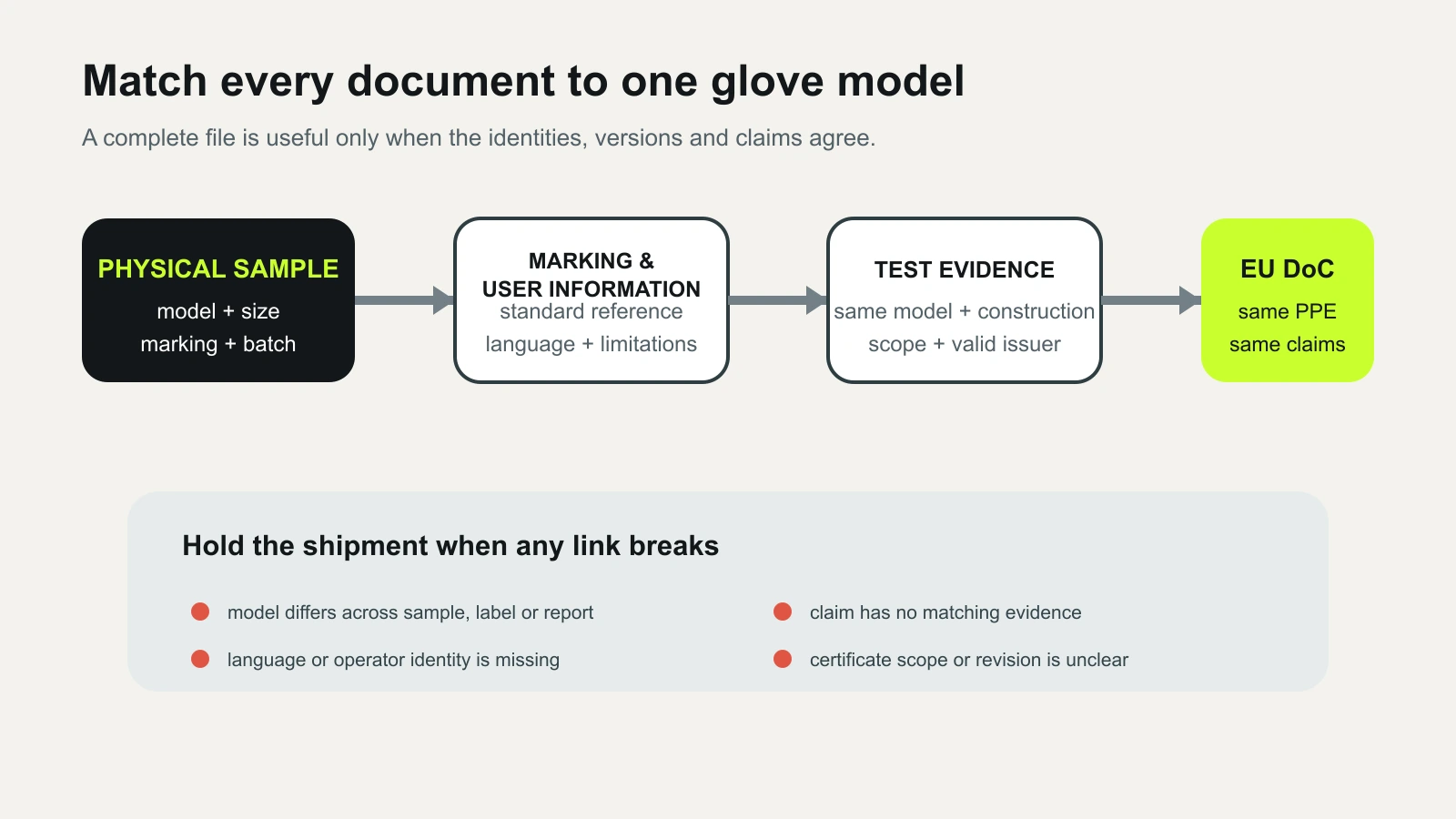
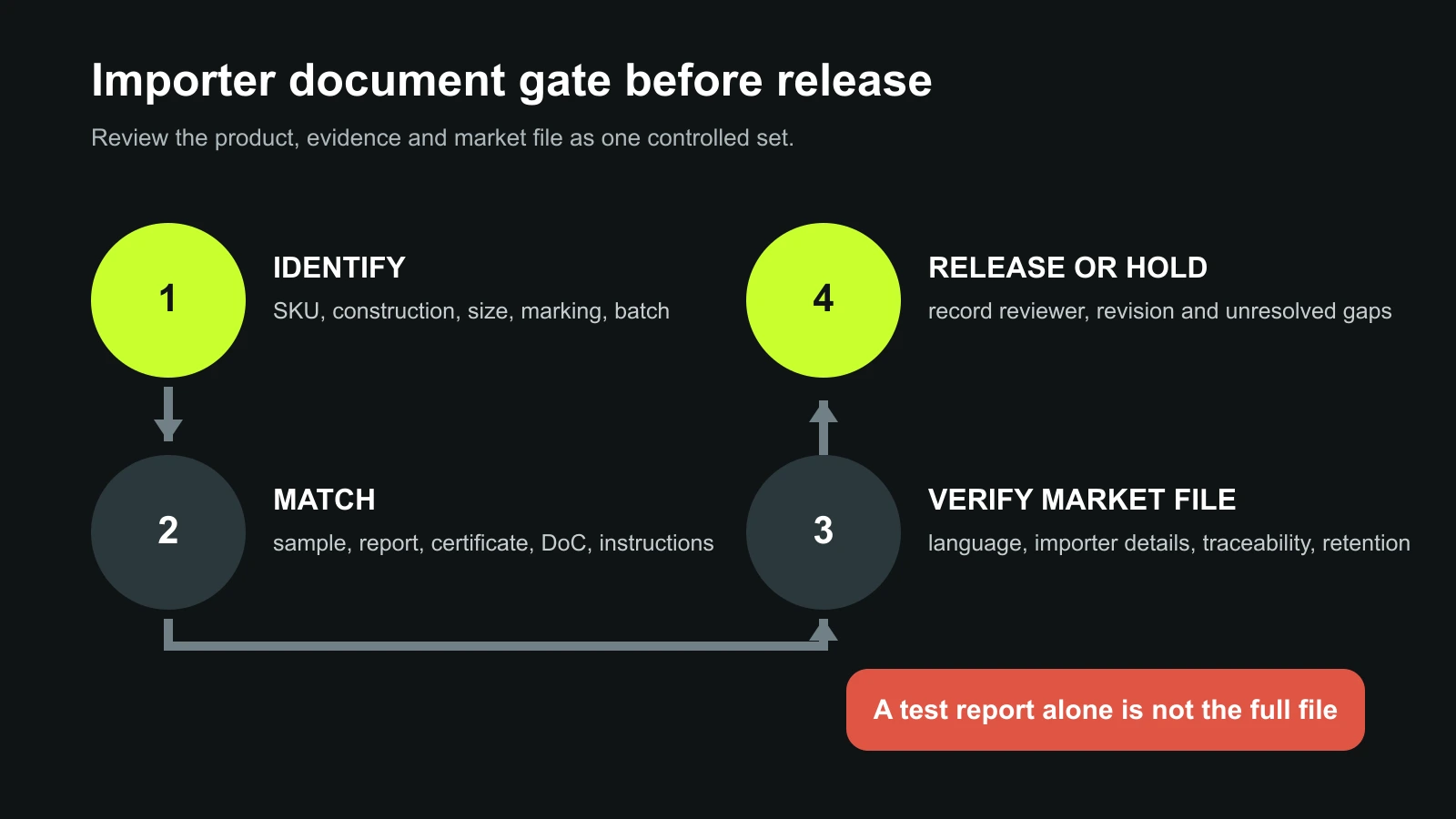
For an EN 388 work glove import, never approve a shipment only because the supplier sent a test report or a photograph of a marking. Build one controlled file for one exact glove model. The physical sample, model code, construction, marking, user information, test evidence, conformity-assessment documents and EU Declaration of Conformity must describe the same PPE and the same claims.
An importer should also verify the required market information, keep a copy of the EU Declaration of Conformity for the required retention period, and be able to make the technical documentation available to authorities on request. If identities, versions or scope fail to match, hold the release and resolve the gap before placing the PPE on the EU market.
This checklist is a procurement and document-control guide, not legal advice and not proof that any particular FENGAN SKU is certified. Compliance has to be confirmed for the exact quoted model and destination market.

Start with the exact glove, not the standard name
“EN 388 glove” is not a complete product identity. EN 388 addresses protective gloves against mechanical risks, but the paperwork still has to point to a particular PPE model. Before checking any performance claim, create a master identity row that includes:
- manufacturer name and contact details;
- supplier and importer details where applicable;
- product or model code;
- commercial description and construction;
- liner, coating, finish and coverage;
- size range and any size-specific marking differences;
- sample revision, artwork revision and packaging revision;
- production or batch traceability field;
- intended use and stated limitations;
- destination market and required language.
Attach each document to this row. A report for “nitrile coated gloves” cannot automatically support a different liner, coating coverage, size range or revised model. A photograph without a readable model link is not enough to close the identity check.
FENGAN's coated work glove sample approval checklist explains how to retain the exact approved reference. The document file should use that same sample identity.
Know what EN 388 proves—and what it does not
The current EU harmonised-standards decision lists EN 388:2016+A1:2018, Protective gloves against mechanical risks. Under Article 14 of Regulation (EU) 2016/425, conformity with a harmonised standard whose reference is published in the Official Journal gives a presumption of conformity only for the essential health and safety requirements covered by that standard.
That boundary matters. An EN 388 reference does not by itself establish chemical, heat, cold, electrical or food-contact suitability. It does not establish that every model in a supplier catalogue has the same results. It also does not replace the manufacturer’s broader obligations under the PPE Regulation.
Use the European Commission's current harmonised PPE standards decision to confirm the published reference, and use the PPE Regulation for the economic-operator, documentation, marking and conformity-assessment duties. Avoid relying on an old blog post or an undated screenshot of a standards list.
Build the importer file in seven sections
The file should make it possible for a reviewer to answer a simple question: does every claim lead back to the same glove model and the correct conformity route?
1. Product identity and approved sample
Keep the approved glove sample or an agreed controlled reference. Record the model code, construction, sizes, visible markings, label artwork, packaging and revision date. Include clear photographs of the glove, cuff or back-of-hand marking, retail or unit packaging, and carton label.
The file should also show which differences are permitted. A color change, liner change, coating-coverage change or private-label revision may affect identity and the required evidence. Never treat a family name as permission to substitute variants.
2. Risk assessment and intended use
Document the hazards the glove is intended to address and the conditions of use. The intended use should agree with the supplied user information, performance claims and quotation. If the buyer requires chemical, thermal or other protection, request the relevant evidence separately instead of stretching an EN 388 file beyond its scope.
Avoid general phrases such as “industrial protection” without a task boundary. Record the mechanical risk context, limits, sizing and any known exclusions. The industrial coated-glove selection guide can help define the job before the document request.
3. Test reports and technical evidence
Ask for test evidence that identifies the tested model or sample unambiguously. Check:
- report number, issue date and issuing body;
- model code and sample description;
- construction and any photographs included in the report;
- test method and standard edition;
- reported results and any “not tested” or not-applicable fields;
- report scope, pages, signatures or authentication method;
- whether later product or artwork changes affect the link to the tested sample.
A test report is evidence, but it is not automatically an EU Declaration of Conformity, an EU type-examination certificate or the complete technical file. The required conformity-assessment route depends on the PPE and risk category. Where a notified body is involved, confirm that the certificate, body identity, scope and model all match the product under review.
4. Product marking and packaging
Compare the glove and packaging markings with the technical file. Review the model identifier, manufacturer identity, CE marking, size, traceability information, pictograms or standard references, and any stated performance code. Check legibility and permanence on the submitted sample.
Never approve artwork from a design file alone. Compare the final physical sample with the approved artwork and the supporting evidence. A correct-looking pictogram does not prove the underlying test or conformity assessment.
5. Manufacturer's user information
Regulation (EU) 2016/425 requires PPE to be accompanied by the user information specified in Annex II, point 1.4, in a language easily understood by users in the Member State where it is made available. The file should therefore include the market-ready version, not only an English draft used during sourcing.
Check that the supplied information identifies the manufacturer, explains intended use and limitations, describes storage, use, cleaning or maintenance where relevant, presents performance information, and explains the meaning of markings. Confirm that the glove model and results match the sample and declaration.
6. EU Declaration of Conformity
The EU Declaration of Conformity is the manufacturer’s formal declaration that the applicable requirements have been fulfilled. Verify that it identifies the PPE model, the manufacturer, the applicable legislation, relevant harmonised standards, the conformity-assessment information where applicable, and the authorized signatory and date.
Regulation (EU) 2016/425 allows the manufacturer either to provide the EU Declaration of Conformity with the PPE or to include in the user information the internet address where it can be accessed. The importer should keep a copy for 10 years after the PPE has been placed on the market and ensure that technical documentation can be made available to market-surveillance authorities on request.
7. Importer and traceability records
Before placing PPE on the market, an EU importer must verify that the manufacturer carried out the appropriate conformity assessment, prepared the technical documentation, applied the CE marking, supplied the required documents, and met the relevant identification duties. The importer must also provide its name, registered trade name or mark, and postal contact address on the PPE, packaging or accompanying document as allowed by the Regulation.
Keep purchase orders, model and batch links, incoming checks, complaints, non-conformity records, corrective actions and distribution traceability in a retrievable system. The European Commission importer guidance gives a useful overview, while the Regulation remains the controlling legal source.
Use a line-by-line consistency table
The most common document failures are not missing PDFs; they are mismatches hidden across several files. Review the set line by line.
| Control field | Physical glove or pack | Test or certificate evidence | User information and EU DoC | Importer action |
|---|---|---|---|---|
| Model identity | Exact code and description | Same tested/certified model | Same PPE model | Hold if codes cannot be reconciled |
| Construction | Liner, coating, coverage, sizes | Sample description supports the same construction | Claims stay within the evidence | Confirm any variant or revision change |
| Standard reference | Marking uses the intended reference | Report uses the applicable edition | Declaration lists the correct standard | Check the current Official Journal reference |
| Performance claims | Marking is legible and complete | Values and scope match the sample | User information explains results and limits | Remove or correct unsupported claims |
| Economic operators | Manufacturer shown where required | Issued to or linked with the correct manufacturer | Manufacturer and signatory agree | Add importer details in the permitted location |
| Language | Market-facing label checked | Evidence may be technical-source language | User information meets destination requirement | Obtain the required translation before release |
| Traceability | Batch or production link is available | Tested reference can be traced | Model remains identifiable | Retain purchase, inspection and distribution records |
Never solve a mismatch by renaming a file. Resolve the actual product-document relationship, record the decision and obtain revised evidence where necessary.
Watch for private-label responsibility changes
Private labeling can change the economic operator’s role. Article 12 of Regulation (EU) 2016/425 states that an importer or distributor is considered a manufacturer when it places PPE on the market under its own name or trademark, or modifies PPE in a way that may affect compliance.
That means private-label buyers should not treat logo and packaging approval as a separate decoration project. Confirm who is legally acting as manufacturer, who owns the technical documentation, whose name appears on the product and declaration, and who manages changes and corrective action. The FENGAN private-label process can structure the commercial discussion, but the responsible economic operator must confirm the legal route for the target market.
Red flags that should stop shipment release
Pause the release when any of these conditions appears:
- the glove model on the report differs from the purchase order or sample;
- the declaration covers a family but does not clearly identify the imported PPE;
- the certificate or test report has missing pages, unclear scope or unverifiable issuer details;
- performance markings exceed, rearrange or omit reported results without explanation;
- a supplier presents a voluntary certificate as the required conformity assessment;
- the user information omits relevant limitations or destination-language requirements;
- manufacturer or importer identification is absent or inconsistent;
- private-label artwork changed the responsible name without updating the conformity file;
- the shipment construction changed after the tested or approved sample;
- a chemical, heat or cut claim is inferred from the coating material or product appearance.
The European Commission warns that voluntary certificates are not a recognized substitute for compliance under EU harmonisation law. Verify the actual legal documents and, where a notified body is required, confirm its relevant scope.
EN 388 document request checklist for an RFQ
Ask every supplier for the same controlled set so quotations are comparable:
- Exact product code, construction, size range and approved sample revision.
- Intended use, limitations and target EU Member State or destination market.
- Clear glove, marking, packaging and carton-label images.
- Applicable EN 388 test evidence linked to the exact model.
- Applicable conformity-assessment certificate or notified-body information, where required.
- EU Declaration of Conformity for the exact PPE model.
- Manufacturer’s user information in the required market language.
- Manufacturer and importer identification plan.
- Batch and production traceability method.
- Change-control process for liner, coating, coverage, color, branding and packaging.
- Retained-sample and shipment-inspection plan.
- Contact person responsible for document revisions and non-conformity handling.
Then compare the exact model against the FENGAN coated work glove range and use the work glove quotation comparison guide to align the file with price, packing and commercial terms. A lower quote that refers to a different construction or incomplete evidence is not a like-for-like offer.
Final release decision
Approve the document file only when one reviewer can trace every marking and claim back to the same glove model, confirm the correct market information, and record the unresolved items as zero. Keep the approved sample, document revision list and importer decision together.
FENGAN can prepare an exact construction and document-request checklist for quotation, but certification and compliance claims will only be made where evidence exists for the specific model. Send the target market, intended use, hazards, construction, sizes, branding requirements and document list through the FENGAN RFQ form. The goal is a verifiable model-specific file—not a folder of unrelated PDFs.