
The best coated work gloves for warehouse handling are selected by task, not by coating name alone. Map what workers touch, how their fingers move, whether surfaces are dry, dusty, wet or oily, and which hazards exist. Then compare complete glove constructions for grip, dexterity, fit, cuff stability, comfort and wear in a controlled worker trial.
A lightweight palm-coated knit glove can be a useful starting point for dry picking, packing and carton handling. It is not automatically suitable for sharp edges, blades, cold rooms, chemicals, wet loads, oily maintenance work or tasks near rotating machinery. Those conditions need their own hazard assessment and, where relevant, verified model-specific protection.
Divide the warehouse into real hand tasks
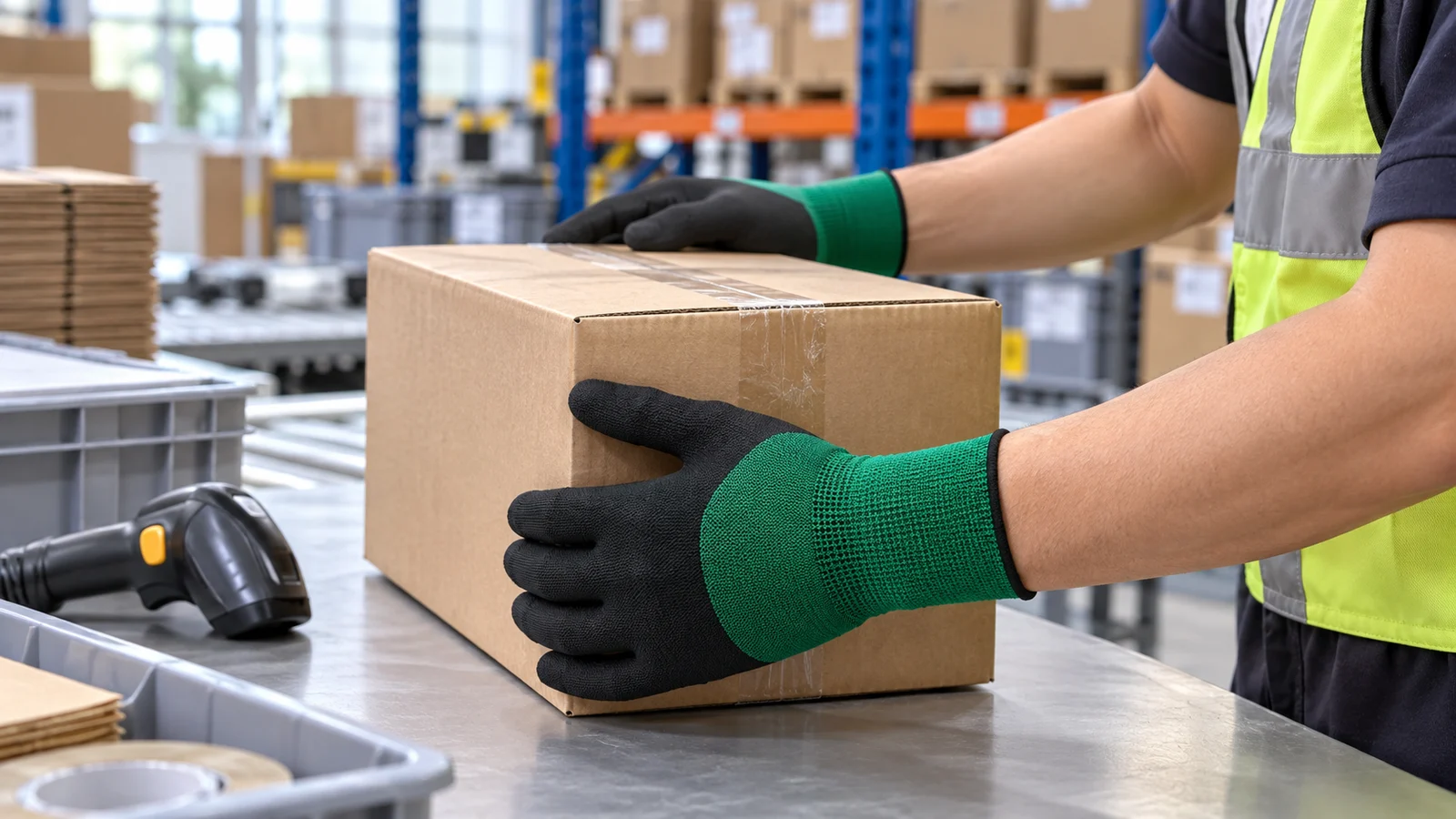
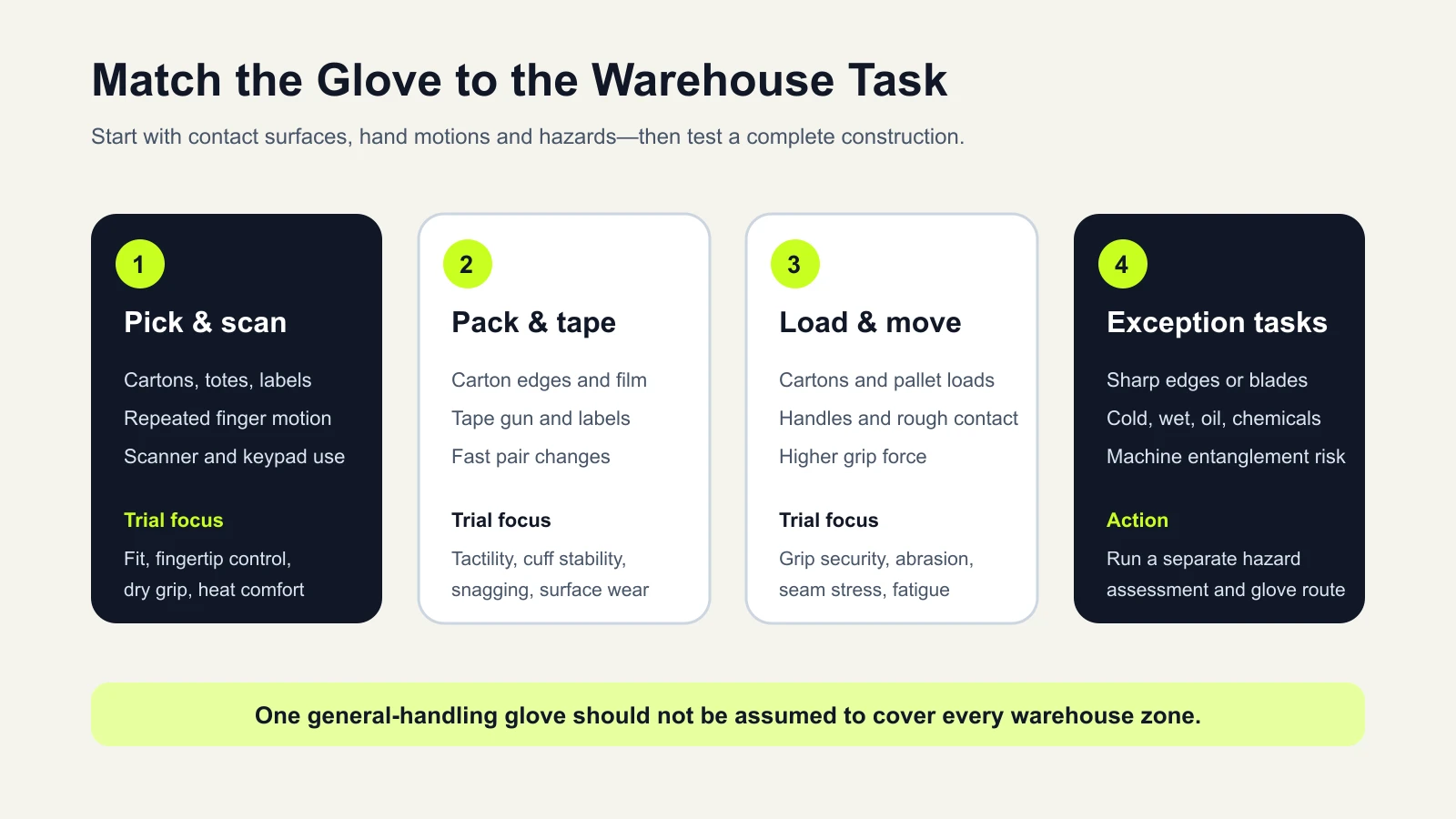
“Warehouse work” is too broad for a reliable glove specification. A picker using a scanner, a packer operating a tape gun and a dock worker moving rough cartons may all work under the same roof, but their hand motions and contact surfaces differ.
Build the task map by walking the process from receiving to dispatch:
- Receiving: carton checks, label handling, pallet wrapping, strapping and damaged-pack investigation.
- Put-away and replenishment: totes, cartons, rack contact and equipment controls.
- Picking: repeated carton and tote contact, scanners, keypads, labels and small-item handling.
- Packing: folding cartons, tape guns, film, labels, inserts and fast pair changes.
- Loading and shipping: heavier cartons, pallet loads, dock hardware and rough contact surfaces.
- Exceptions: broken pallets, exposed staples, sharp metal, box cutters, spills, cold storage, maintenance and machine-related work.
Record the surfaces, object size, grip type, pace, shift length, temperature and contamination for each task. This makes the RFQ specific enough for a supplier to propose a construction and for workers to test it consistently.
OSHA's PPE selection guidance says no glove protects against every hand hazard and selection must match the application. HSE similarly advises balancing protection with dexterity and choosing grip texture for wet or oily objects. Those principles matter in a warehouse because a general handling glove can become the wrong glove when the task changes.
Start with the hazard boundary
Before comparing coatings, identify what the glove must protect against and what it must not interfere with. Ask:
- Are workers handling only clean cartons and plastic totes, or also sharp, broken or contaminated items?
- Are utility knives, metal bands, staples, splinters or damaged pallets present?
- Is there contact with oil, water, cleaning chemicals, refrigerants or unknown spills?
- Does the task involve cold rooms, hot surfaces, vibration or impact?
- Could a glove be caught in moving or rotating equipment?
- Which controls already remove or isolate the hazard before PPE is considered?
The answer may split one department into several glove programs. For example, a light picking glove can be tested for scanner control and carton grip, while blade use follows a separate cut-hazard route. Chemical cleanup should not inherit the same glove merely because both products contain nitrile somewhere in their names.
The coating family or coverage alone is not proof of chemical resistance, cut resistance, puncture resistance, waterproof performance, thermal protection or certification. Confirm any protection claim for the exact quoted model and applicable evidence.
Translate each task into buying criteria
Use an explicit decision table so different buyers and suppliers evaluate the same requirements.
| Warehouse task | Contact and hand motion | Trial priorities | Escalation trigger |
|---|---|---|---|
| Scanner-heavy picking | Cartons, totes, labels, keypad and repeated pinch grip | Close fit, fingertip control, dry grip, cuff stability, heat comfort | Mis-scans, glove bunching, loose fingertips or frequent removal |
| Packing and labeling | Carton edges, tape gun, film, inserts and labels | Tactility, controlled grip, snag resistance, fast donning and pair consistency | Tape fouling, label-control loss, seam pressure or cuff roll |
| Replenishment | Mixed cartons, tote handles and rack contact | Grip security, flexibility, abrasion pattern and size retention | Surface slip, rapid palm wear or interference with equipment controls |
| Loading and shipping | Larger cartons, pallet loads and rougher contact | Secure grip, seam stress, cuff stability, fatigue comments and wear | Excess grip force, torn liner, coating separation or unsuitable hazard protection |
| Sharp or contaminated exceptions | Blades, staples, metal, broken pallets, spills or chemicals | Separate hazard assessment and verified protection for the exact model | General-handling glove has no verified evidence for the exposure |
The table is a specification starter, not a universal product recommendation. Your loads, carton coatings, pace, climate and workforce will change the result.
Compare the complete glove construction
Coating material and finish
Nitrile, latex and PU are broad coating families. Their finish, thickness, coverage and liner change how the glove feels and handles. Smooth, foam, crinkle and textured surfaces should be treated as different constructions rather than interchangeable names.
For a dry carton task, compare actual grip and release behavior: the glove should hold the load without forcing the worker to squeeze harder, yet should not feel so tacky that it disrupts fast handling. If surfaces can be wet or oily, record that condition in the trial instead of assuming a textured-looking coating guarantees performance.
Coating coverage
Palm coating leaves the knit back exposed and can support flexibility and heat release in suitable tasks. More coverage changes breathability, stiffness, contamination control and protection boundaries. Select coverage from the task and hazard assessment, not from the idea that “more coating” always means “better.”
Liner and gauge
The liner influences fit, stretch, bulk, heat and finger control. A finer knit can feel more responsive, while a heavier construction may feel more robust, but gauge alone does not prove durability or protection. Compare the exact liner, gauge, yarn and coating combination.
FENGAN's FG-NF01 foam nitrile coated glove is one approved visual construction example: a 15-gauge nylon/spandex liner with microfoam nitrile palm coating is listed as an RFQ starting point. It is not a blanket recommendation for every warehouse zone; final suitability, claims and specifications depend on the exact task, approved sample and current quotation.
Size and fit
NIOSH ergonomics guidance notes that tight gloves can put pressure on hands, while loose gloves reduce grip strength and can create other hazards. Warehouse trials should therefore include the real size range rather than one sample size shared by everyone.
Check fingertip length, palm bunching, thumb crotch, cuff hold and pressure after repeated motion. A worker should be able to operate scanners, labels and controls without repeatedly pulling the glove back into position. Use the work glove size-mix guide to build an initial size allocation from worker data rather than prescribing one universal ratio.
Run a controlled worker sample trial
A supplier sample should answer a purchase question, not just look acceptable on a desk. Compare two or three candidate constructions on the same tasks, under the same approximate duration and scoring fields.
Define the trial before issuing samples
Record:
- warehouse zone and task;
- surfaces, loads and contamination state;
- tools and devices used;
- trial duration or task count;
- worker and glove size;
- candidate model and sample revision;
- starting condition and photographs;
- scoring scale and stop conditions;
- replacement trigger;
- person authorized to accept the result.
The coated glove sample approval checklist can retain construction, artwork and measurement details. The warehouse trial adds task performance and wear evidence to that controlled sample.
Score what the worker actually experiences
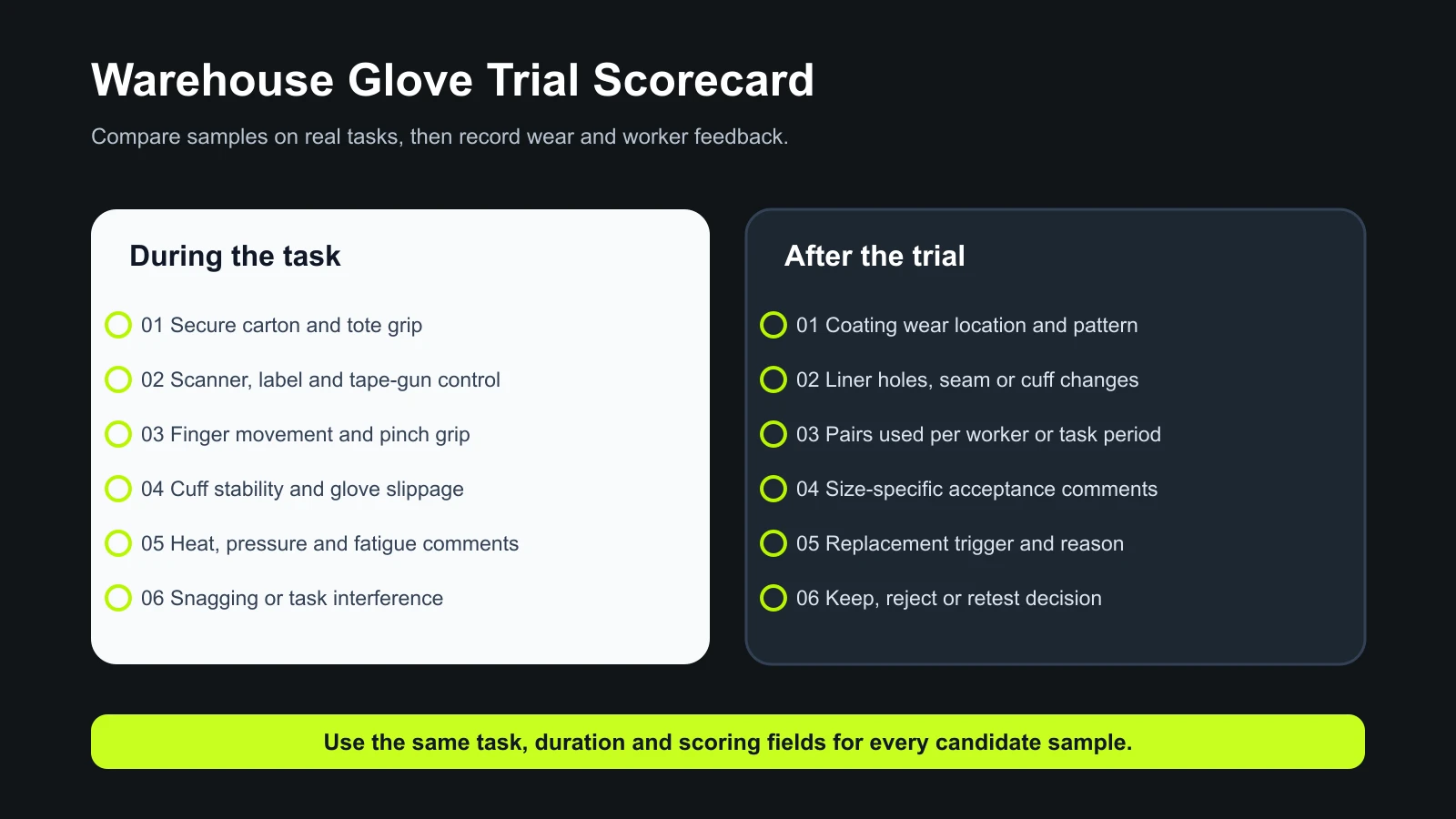
Ask workers to score grip security, fingertip control, fit, pressure points, heat, sweating, cuff movement, snagging and interference with scanners or tools. Invite specific comments such as “extra material at the index fingertip caused keypad errors,” not only “comfortable” or “uncomfortable.”
Observe technique as well. A worker may compensate for weak grip by squeezing harder, holding a carton differently or removing the glove for labels. These behaviors can reveal a task mismatch even when the sample remains intact.
Inspect wear after the same exposure
Photograph and record coating wear at fingertips, thumb crotch and palm; liner holes; seam changes; cuff stretch; delamination; contamination and loss of shape. Compare by size and task. A pair that performs well for light picking may wear differently in loading.
Avoid publishing a service-life promise from a short trial. Instead, record pairs consumed per defined task period and repeat the measurement after deployment. The buyer can then compare cost using its own observed data.
Decide with evidence, not one average score
Use a release rule that preserves safety boundaries:
- Approve for a named task: the candidate meets the task's fit, handling and wear requirements and has the required model-specific evidence.
- Approve with a size or process condition: only defined sizes, zones or procedures passed; record the boundary.
- Retest: feedback conflicts, the trial was too short, the sample revision changed or the task conditions were not representative.
- Reject for that task: the glove interferes with work, shows unacceptable wear or lacks required protection evidence.
- Route to another glove program: the task includes a hazard outside the general-handling specification.
Keep minority feedback visible. An average score can hide a serious size problem or one task where the glove slips. Segment results by task, size and worker group before choosing the order specification.
RFQ checklist for warehouse handling gloves
Send suppliers the same fields so proposals are comparable:
- Warehouse zones and named tasks: receiving, picking, packing, replenishment, loading or exceptions.
- Contact surfaces: carton, plastic tote, stretch film, pallet, metal rack, label, handle or other material.
- Surface condition: dry, dusty, wet, oily, cold or contaminated.
- Hazard assessment boundary and any required model-specific protection.
- Preferred coating family, finish and coverage—or permission for alternatives.
- Liner material, gauge and fit expectations.
- Worker size data and required size range.
- Color, branding, label and packing requirements.
- Sample quantity for the controlled task trial.
- Trial scorecard, duration and replacement trigger.
- Required test, compliance and destination-market documents for the exact model.
- Order quantity, size mix, carton plan and current commercial terms.
- Change-control rule between approved sample and bulk production.
- Pre-shipment inspection and retained-sample requirements.
Use the FENGAN coated work glove range to identify candidate families, then apply the bulk glove quality inspection checklist after sample approval. Every final claim, tolerance, packing field and performance requirement should be tied to the exact quoted construction.
Common questions
Are nitrile-coated gloves always best for warehouse work?
No. Nitrile-coated constructions are common candidates for handling tasks, but suitability depends on finish, coverage, liner, fit, surfaces, hazards and the exact model. Latex, PU or another construction may suit a defined task better. Test complete samples rather than selecting by coating family alone.
Should one warehouse use one glove style?
Only if the hazard assessment and task trials support it. Picking, loading, blade use, cold storage and spill response can require different controls or glove programs.
How many workers should join the trial?
There is no universal number in this guide. Include representative tasks, shifts, hand sizes and worker groups, and define the sample plan before the trial. Increase coverage when results vary or the risk is higher.
Can a warehouse glove trial prove cut or chemical protection?
No. A workplace trial can assess handling, fit, comfort and observed wear. Cut, chemical and other protection claims require appropriate evidence for the exact product and intended use.
What should trigger glove replacement?
Set task-specific triggers before deployment, such as holes, coating separation, loss of grip, contamination that cannot be managed, damaged cuffs, altered fit or any condition that compromises the required protection. Train workers to report and replace affected pairs.
Build the warehouse glove specification from the task
FENGAN can organize a sample and RFQ around the actual warehouse process. Send the task list, surfaces, hazards, size data, expected quantity, branding, packing, destination requirements and trial plan through the FENGAN RFQ form. The useful outcome is a named construction approved for named tasks—with evidence and boundaries that can be carried into bulk inspection.