
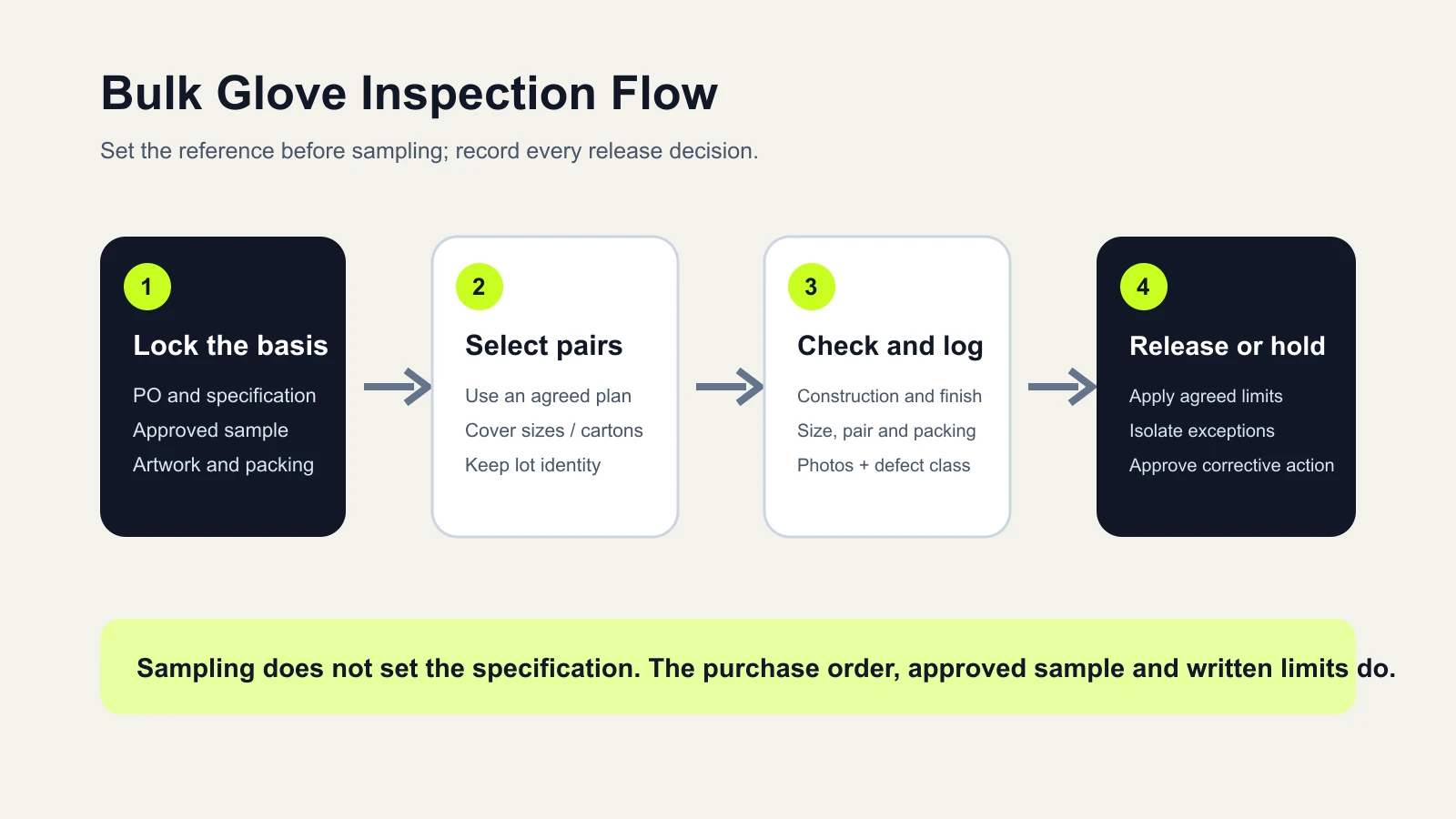
A useful work glove quality inspection checklist starts with the purchase order, written specification and approved sample—not with a generic defect list. The inspector then selects pairs under an agreed sampling plan, checks construction, dimensions, coating, pair consistency, visible workmanship, quantity and packing, and records a release, hold or corrective-action decision against limits set before production.
This matters because “acceptable quality” is not a universal number. A buyer and supplier must agree what counts as a critical, major or minor nonconformity, which sampling system applies, and which tolerances control the order. ISO 2859-1:2026 provides sampling schemes indexed by acceptance quality limit for lot-by-lot inspection, but it does not choose your product specification or commercial acceptance limits. Those decisions belong in the order documents.

Freeze the inspection basis before production
An inspector cannot judge consistency if the reference keeps moving. Before the production lot is available, assemble one controlled inspection pack:
- purchase order number, supplier model and buyer item code;
- approved glove sample or clearly identified retained reference;
- written construction: liner, gauge where confirmed, coating material, finish, coverage, cuff and color;
- approved size range and size identification method;
- agreed dimensional or pair-weight tolerances where the buyer uses them;
- logo, label, barcode, polybag, bundle and carton artwork revisions;
- quantity and size assortment by carton;
- agreed test or compliance documents for the exact model and destination;
- defect definitions, severity classes and acceptance limits;
- sampling standard, inspection level and plan selected by the responsible buyer or quality professional;
- required photographs, measurement records and sign-off authority.
Record revision dates. A production glove should be compared with the final approved reference, not an earlier sales sample or a photograph from another coating family. If a requested construction changed after sample approval, resolve the change before inspection rather than asking the inspector to guess which version controls.
FENGAN's coated work glove sample approval checklist explains how to establish that reference. The bulk inspection should continue the same identity trail.
Separate the lot, sample and pair
Inspection records should make three levels traceable:
- Lot: the defined production quantity presented for inspection, with date, item, color, size mix and carton range.
- Sample: the cartons and pairs selected from that lot under the agreed plan.
- Finding: the exact pair, pack or carton where a nonconformity was observed.
The sample should represent the order rather than the easiest cartons to reach. Spread selection across carton locations and sizes according to the agreed plan, and record the selected carton numbers. Keep sampled pairs separate until the count and findings are reconciled.
ISO describes acceptance sampling as a way to evaluate a lot from a sample. It is not a guarantee that every unit is conforming, and it is not a substitute for process control. If the buyer requires ISO 2859-1, use the current licensed standard and a competent quality professional to determine the code letter, sample size, switching rules and accept/reject values. Copying an AQL table from an unrelated web page can apply the wrong edition, lot range or inspection setting.
Inspect product identity first
Before counting cosmetic findings, confirm that the shipment is the ordered product. Compare the sampled pairs and packing with the master identity row.
| Identity field | What to compare | Hold trigger |
|---|---|---|
| Product code | PO, glove label, polybag and carton | Codes identify different products or cannot be reconciled |
| Coating family | Nitrile, latex, PU or PVC as ordered | Material or family differs from the approved specification |
| Coating coverage | Finger, palm, three-quarter or full coverage as applicable | Coverage is visibly different from the approved sample |
| Surface finish | Smooth, foam, crinkle or textured as specified | Finish changes grip surface or product identity |
| Liner and cuff | Material, knit appearance, cuff type and approved gauge where confirmed | Construction is substituted or mixed within the lot |
| Size and color | Marking, physical comparison and assortment | Wrong size marking, mixed pairs or unauthorized color variation |
| Branding | Logo, placement, orientation and artwork revision | Wrong brand, distorted artwork or unapproved placement |
The coating family alone proves none of chemical resistance, cut resistance, puncture resistance, waterproof performance, thermal protection or certification. Those claims require model-specific evidence. Inspection may verify that markings and documents match the approved model, but visual appearance cannot create a performance claim.
Check the glove construction and workmanship
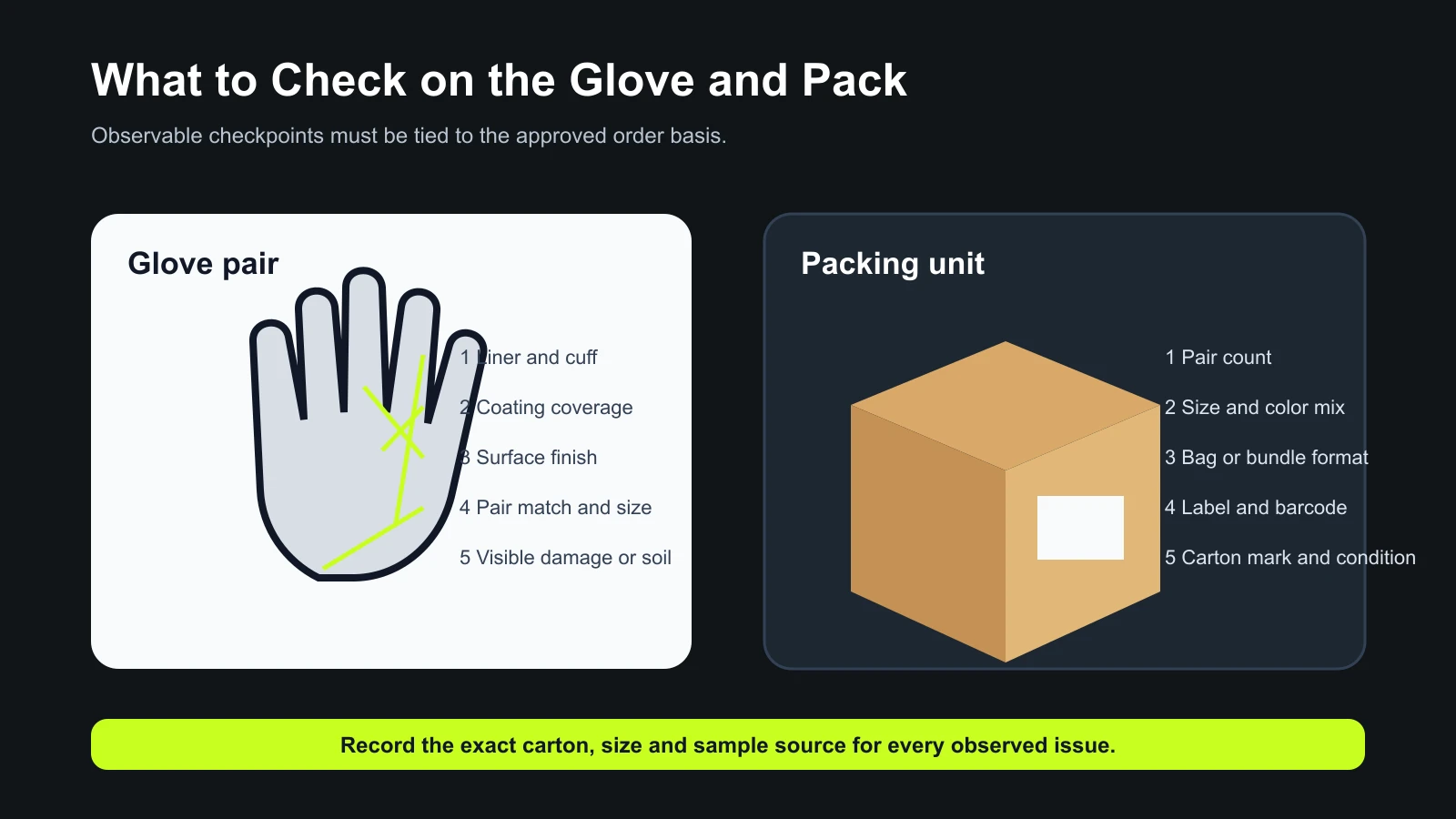
Work from the whole pair toward individual details. Compare left and right gloves, then compare pairs across the sample. Record counts by defect type instead of writing only “quality bad.”
Liner and knit
Review the liner material and knit appearance against the approved sample. Look for holes, dropped stitches, open seams, loose yarn, contamination, severe distortion and cuff inconsistency. Check whether the thumb crotch, fingertips and cuff are formed consistently. If the order specifies a gauge or yarn construction, verify it using the agreed method rather than estimating from appearance.
Coating coverage and finish
Compare coating boundaries, thickness appearance, finish and color with the approved reference. Look for missed areas, excessive bleed, exposed zones outside the approved boundary, bubbles, cracks, peeling, sticky surfaces, hardened areas, foreign particles and obvious unevenness. A visual check can identify production variation; it cannot establish chemical or mechanical test performance.
Pair consistency
Confirm that two gloves in a pair have the same size, color, cuff treatment, coating coverage and branding orientation. Compare finger length, overall silhouette and cuff opening. A single acceptable glove paired with the wrong size or shade is still a packing nonconformity.
Dimensions and weight
Measure only against values and tolerances that were agreed in writing. Use calibrated equipment appropriate to the measurement and record the method—for example, where overall length begins and ends, whether the glove is laid flat, and whether pair weight is conditioned or checked as received.
A historical weight from one size or construction should not be applied across all sizes. If pair weight is a purchasing control, the order needs size-specific targets or an approved tolerance basis. Keep actual readings, not only a pass mark.
Classify findings against buyer risk
Defect severity should reflect the intended use, contract and destination requirements. A practical framework is:
- Critical: a condition that may create an unacceptable safety or regulatory risk, or a wrong identity that invalidates required evidence.
- Major: a condition likely to cause product failure, loss of intended function, customer rejection or a material departure from the approved specification.
- Minor: a limited workmanship or appearance variation that does not materially affect intended use but exceeds the agreed standard.
This framework still needs order-specific examples. For one buyer, an unreadable size mark may be major because warehouse picking depends on it. For another program, a slight approved shade range may be acceptable. Define photographs or boundary samples where words leave room for interpretation.
Never reclassify a finding after the count merely to obtain a passing result. If the defect list was incomplete, place the lot on hold, document the new condition and have the authorized parties agree how it will be evaluated.
Verify packing as carefully as the glove
Packing errors can turn a conforming product into an unusable delivery. Inspect from pair to export carton:
- left/right pairing and pair count;
- size and color assortment;
- individual bag, bundle or dozen format;
- desiccant or inserts only where specified and permitted;
- retail label, barcode and country or market information where applicable;
- inner-box quantity and markings;
- export-carton dimensions, gross/net weight fields and carton numbering;
- carton mark, buyer reference, destination and handling marks;
- closure method, carton strength appearance and visible transit damage;
- pallet pattern, wrapping and pallet label when part of the order.
Perform a count reconciliation. Multiply pairs per pack, packs per carton and cartons presented, then compare the result with the size-level packing list and purchase order. Investigate partial cartons and replacements separately.
Build an inspection record that supports a decision
The report should let a buyer who was not present understand what was inspected and why the decision was made. Include:
- supplier, factory, buyer, PO and item identity;
- inspection date, location and production status;
- lot quantity presented and packing completion percentage;
- sampling standard and plan selected by the responsible party;
- carton numbers and size distribution sampled;
- approved sample and specification revision used;
- equipment used and calibration status where measurements matter;
- actual measurements and finding counts by defect class;
- representative photographs with captions and sample identity;
- quantity and packing reconciliation;
- unresolved deviations or concessions;
- release, hold, rework or reinspection decision;
- names and authority of the people approving any exception.
Photographs should show context, detail and scale. One close-up of a coating mark without the pair, size or carton source may be impossible to trace later. Keep file names and captions linked to the finding log.
Use a clear release-or-hold gate
The final result is more than “pass” or “fail.” Choose the disposition supported by the agreed plan and evidence:
| Decision | When it fits | Required record |
|---|---|---|
| Release | Identity, findings, quantity and packing meet the agreed requirements | Signed report and shipment identity |
| Conditional release | The buyer formally accepts a defined deviation | Written concession, affected quantity and commercial disposition |
| Hold | Identity, evidence or finding classification is unresolved | Segregated lot, issue list, owner and response deadline |
| Rework and reinspect | Correctable findings exceed the limit or packing needs correction | Rework scope, traceability and a new inspection result |
| Reject | The authorized buyer applies the agreed rejection rule | Report, evidence, contract reference and disposition plan |
Payment pressure or vessel timing should not change the inspection basis. If shipment proceeds under a concession, record who accepted the risk and exactly which quantity or deviation it covers.
Buyer checklist for the inspection booking
Send the inspector or supplier this information before the visit:
- Purchase order, item code and total pairs by size and color.
- Exact coated-glove construction and approved sample reference.
- Final artwork and packing revisions.
- Lot definition and minimum completion state for inspection.
- Sampling standard, edition, inspection level and acceptance limits selected by the buyer.
- Critical, major and minor defect definitions with boundary examples.
- Measurement methods and approved tolerances.
- Required compliance-document and marking checks for the destination.
- Carton-selection, photo and reporting requirements.
- Authorized contacts for a hold, concession or reinspection decision.
Use the work glove quotation comparison guide to make sure inspection requirements are priced and assigned before the order. If private-label packing is involved, align approvals through the FENGAN private-label process.
Common questions
What is checked during a coated work glove inspection?
The inspection normally covers product identity, liner and cuff, coating coverage and finish, pair consistency, size and agreed dimensions, visible workmanship, branding, quantity, inner packing, labels and export cartons. The exact checkpoints and limits must come from the purchase order, approved sample and written specification.
Who should set the AQL and defect limits?
The buyer or responsible quality professional should set them with the supplier before production, based on product risk, contract requirements and the chosen sampling system. A glove factory should not silently choose acceptance limits after defects are found.
Is a passed sampling inspection a guarantee of the whole shipment?
No. Acceptance sampling uses a selected sample to make a lot decision under a defined statistical plan. It does not inspect every pair or guarantee zero defects. Process controls, approved samples and traceability remain important.
Can visual inspection confirm EN or ANSI performance?
No. Visual inspection can compare construction and markings with the approved model. Performance or certification claims require valid model-specific documents and, where applicable, testing and conformity assessment.
When should a shipment be held?
Hold it when product identity is uncertain, the inspected lot is incomplete or mixed, required evidence is missing, findings cannot be classified, results exceed agreed limits, or packing and quantity cannot be reconciled. Release follows only after the authorized party resolves and records the issue.
Turn the checklist into an order-specific QC plan
FENGAN can align coated glove construction, sample approval, packing and order-control fields for a quotation. Send the intended application, coating family and finish, coverage, liner, sizes, quantity, branding, packing, destination market, required documents and your inspection plan through the FENGAN RFQ form. The result should be an order-specific checklist that both buyer and factory can apply—not a generic pass mark added at the shipping deadline.